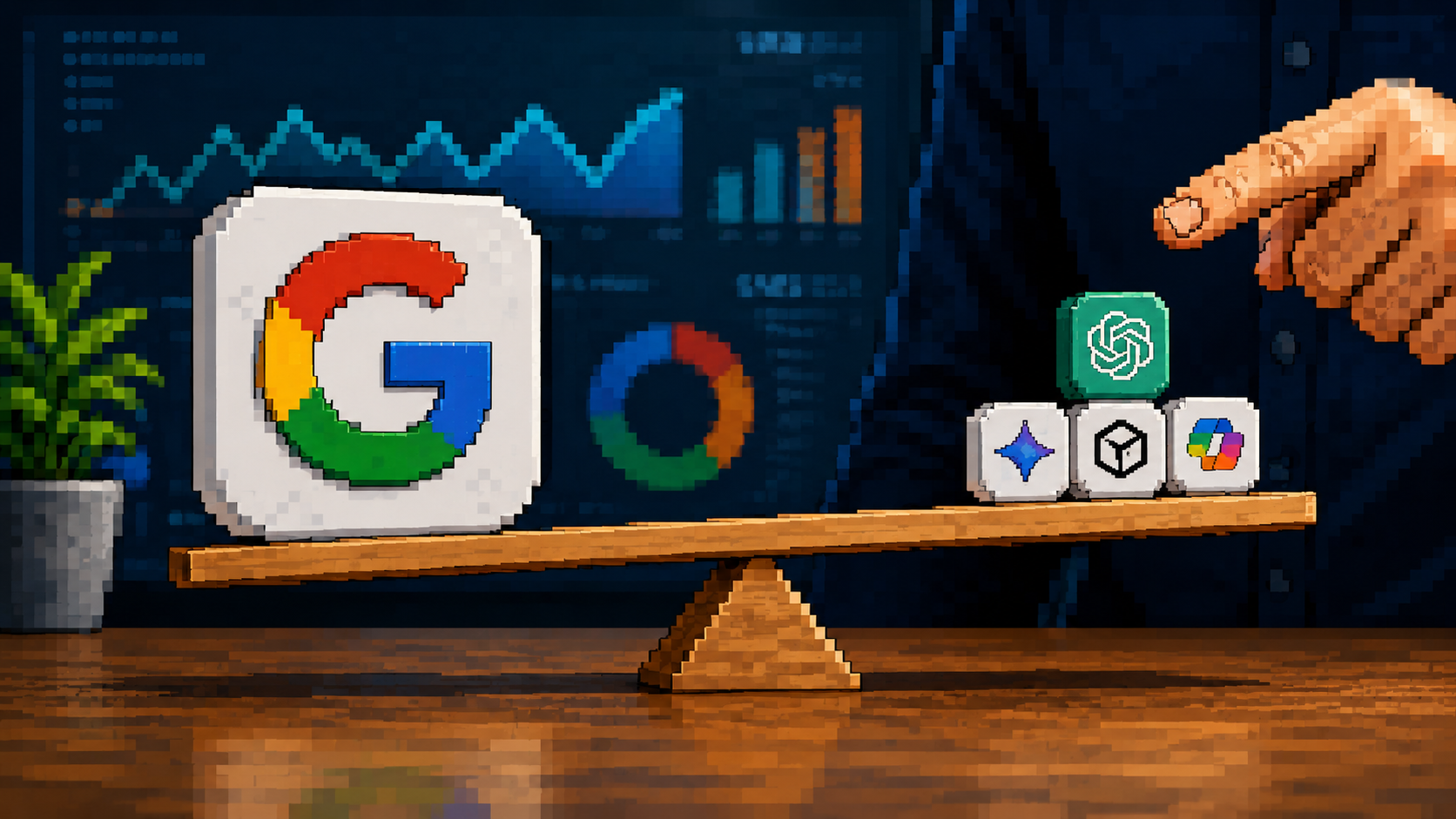
Yes, SEO still works. Google drives over 169 times more website traffic than all AI platforms combined, and the number one organic result earns a 27.6% click-through rate. What has changed is the strategy: focus on structured, helpful content with FAQ schema, topical authority, and a fast, technically sound website to rank in search and appear in AI answers.
If you have been told that SEO is dead, you have been told something that is not true. If you have been told that SEO in 2026 is the same as it was in 2021, that is also not true.
SEO for small businesses in 2026 is not about keyword placement. It is about building a content ecosystem that demonstrates genuine expertise on a specific subject to both Google and AI tools simultaneously, so that every piece of content you publish strengthens every other piece and the cumulative result is a business that is consistently found by the right people at every stage of their decision.
The honest position is that SEO has evolved significantly in the last three years, in specific and identifiable ways, while its foundational principles remain intact. Understanding exactly what changed and what did not is the most important thing a small business owner can know before making any decision about how to invest in search visibility.
This guide covers the full picture: what SEO is and why it still matters, what has genuinely changed, what the new requirements look like in plain language, and where a small business with limited time and budget should start.

What SEO Actually Is in 2026
What is SEO for small businesses and does it still matter?
SEO is still vital for businesses of all sizes in 2026, perhaps even more true for small businesses. It still works, and Google still cares about your SEO efforts, even in the face of AI Overviews, zero-click searches, and AI search optimization.
SEO is the practice of making your website findable, understandable, and trustworthy to the systems that determine whether it gets found when potential clients search for what you offer.
For small service businesses specifically, SEO matters for a reason that has not changed: it is the highest-return long-term investment available for consistent, compounding client acquisition. Unlike paid advertising, which stops producing the moment you stop paying, SEO builds cumulative authority that grows over time and continues generating visibility long after the initial investment.
SEO in 2026 is actually more fair, more logical, and more aligned with good business practices than it used to be. The focus has shifted from simply ranking to being the most helpful, authoritative answer for a user's problem.
This shift is good news for small businesses with genuine expertise. The businesses that used to win on SEO through large backlink budgets and keyword density manipulation are losing ground to businesses that actually know their subject matter and write about it specifically and helpfully. That levels the playing field in a way that favors the expert practitioner over the large-budget content factory.

What Has Changed
How has SEO changed for small businesses in 2026?
Three changes are significant enough to affect strategy.
Zero-click searches are increasing.
Across all Google searches, 43% now end without any click to an external website, a figure that rises to 93% when Google's AI Mode is active. This means that ranking on page one no longer reliably translates to the same volume of website traffic it once did. Buyers are getting answers directly on the results page. The businesses whose content provides those answers, even without getting the click, are building brand recognition and authority in search. The businesses whose content does not provide those answers are simply absent from the conversation.
AI Overviews have changed the value of position one.
When an AI Overview appears at the top of a search result, it pushes traditional blue links down the page. Being cited in the AI Overview now carries more value than being ranked first in traditional results. The businesses being cited in AI Overviews are not always the ones ranked first in traditional results. They are the ones whose content is structured for AI extraction.
Topical authority has replaced keyword optimization as the primary content strategy.
In 2026, Google rewards websites that show depth and consistency, not just volume. Publishing random blog posts on unrelated topics does not work anymore. Building topic clusters creates topical authority. A site with ten interconnected articles on a specific subject will consistently outperform a site with one optimized page on the same subject.

What Has Not Changed
What SEO fundamentals still apply in 2026?
The fundamentals that remain unchanged are the ones that were always about genuine helpfulness rather than algorithmic manipulation.
Technical crawlability.
Your site must be accessible to search engine crawlers. Fast load times, mobile optimization, clean URL structure, and a properly configured robots.txt file are as important as they have ever been.
Content quality and specificity.
Thin, generic content has never ranked well for anything meaningful. In 2026, the definition of quality includes being structured for AI extraction, but the underlying requirement for genuine helpfulness and specificity is unchanged.
Local signals for local businesses.
Amid all the changes, the core of local SEO has not moved. NAP consistency, your business name, address, and phone number need to be identical across every online listing, Google Business Profile, Yelp, industry directories, your website, social profiles.
E-E-A-T.
Google's framework for evaluating Experience, Expertise, Authoritativeness, and Trustworthiness was not invented in 2026. It has been built into Google's quality evaluation for years. What has changed is how explicitly it maps to content structure and author attribution requirements. Named authors with verifiable credentials, specific claims with verifiable sources, and content that demonstrates genuine knowledge of the subject matter are increasingly differentiated from anonymously written, generic content.

Where Small Businesses Should Start
What is the most important SEO priority for a small business in 2026?
If you are not already on Google Business Profile, start there. This is especially important for local businesses. Keeping it updated, responding to reviews, and posting regularly sends strong signals to Google and increasingly to AI tools that recommend local businesses.
For most small service businesses, the highest-return starting points in order of priority are these.
First: Technical foundation.
If your site is slow, not mobile-optimized, or has crawlability problems, fix these before any content investment. Content on a technically broken site will not rank regardless of its quality.
Second: Google Business Profile.
For local and regional service businesses, a complete, active, well-reviewed Google Business Profile is one of the highest-return SEO assets available. It feeds Google's local results, Google AI Overviews, and Gemini's recommendations simultaneously.
Third: Topical content strategy.
Choose one subject area your business genuinely owns expertise on. Build a pillar article covering the topic comprehensively. Build cluster articles covering specific subtopics in depth. Connect them with intentional internal links. This is the content architecture that builds topical authority over time.
Fourth: Answer-structured content.
Every article, every service page, and every FAQ section should be structured so that the main question each section answers is stated in the heading and answered completely in the first sentence. This is the structure that earns featured snippets, Google AI Overview citations, and AI tool recommendations simultaneously.
Fifth: Schema markup.
Organization schema on your homepage and FAQ schema on pages with question-and-answer content significantly improve both traditional search rich results eligibility and AI citation eligibility. This is a developer task that has an outsized impact relative to its implementation cost.
The Connection Between SEO and AI Visibility
How does SEO relate to AI search visibility in 2026?
SEO and AI visibility are not competing priorities. They are complementary disciplines that, when combined into a unified strategy, reinforce each other in powerful ways. Strong SEO creates the crawlable, authoritative content that feeds AI models. AI visibility optimization shapes how that content is written and structured so it gets cited and recommended. Together, they form the new playbook for organic growth.
The content that ranks well in Google and the content that gets cited by AI tools are built on the same foundation: fast, crawlable, well-structured, genuinely helpful, specifically written, and verified by external signals. The strategy that serves both goals is the same strategy.
The businesses investing in SEO correctly in 2026, with topical authority architecture, answer-structured content, technical foundations in place, and schema markup implemented, are simultaneously investing in AI visibility. One investment serves both channels at once.

Frequently Asked Questions