
Almost everyone looks at a web design portfolio the wrong way.
They scroll through screenshots, decide whether the work looks attractive, and form a judgment based on aesthetic preference. That tells you almost nothing about whether the designer can build a website that works for your business.
A website is not an art piece. It needs to load quickly, work on a phone, rank in search, guide visitors toward contacting you, and be easy for you to update after launch. A screenshot tells you almost nothing about any of those things.
Here is how to actually evaluate a portfolio before you hire a web designer, whether you're choosing someone locally or considering a web design studio in the Philippines.
Start With the Live Sites, Not the Screenshots
Why should I look at live websites instead of portfolio screenshots?
Screenshots are selected by the designer to show their work at its best angle. They are cropped, sized, and presented to emphasize the visual. The live site is the full picture.
Ask for live URLs for every portfolio piece you are considering. Then visit them yourself. Don't just look at the homepage. Navigate to the services page, the contact page, the about page. Try to find information quickly. Try to complete the next step the site is asking you to take.
What you are checking: does the site make it immediately clear what the business does? Is there a visible call to action above the fold? Does the navigation make sense? Is the messaging specific and client-focused, or is it vague and generic?
A designer who built strong, clear, conversion-minded sites for previous clients is likely to build one for you. A designer whose client sites have unclear messaging and buried calls to action will bring the same thinking to your project.
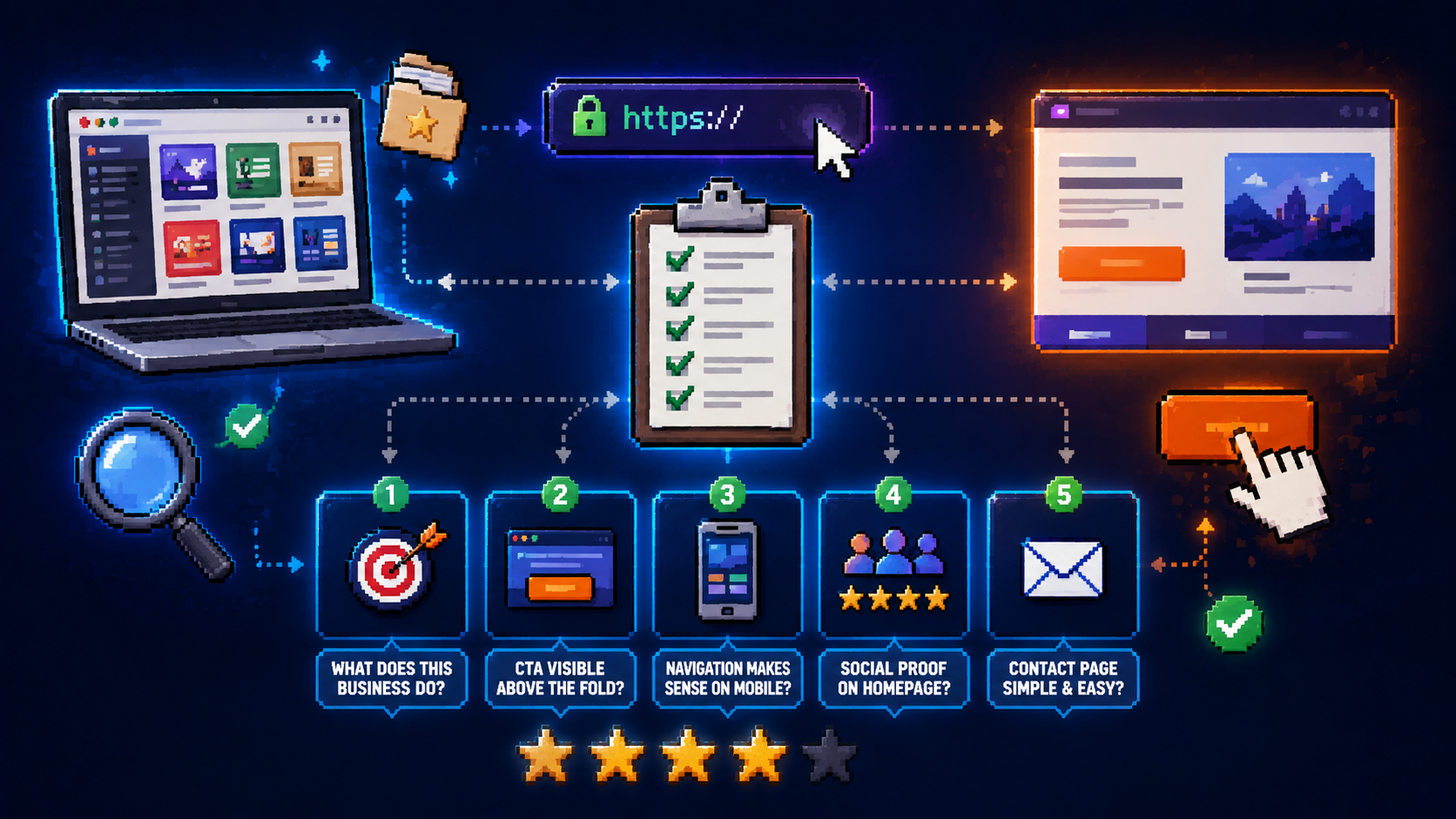
Your live site checklist for each portfolio piece:
- What does this business do? Could you answer in five seconds?
- Is there a call to action visible without scrolling?
- Does the navigation make sense on mobile?
- Is there any social proof visible on the homepage?
- Does the contact page feel simple and easy?
Score each site yes or no on all five. A designer who scores five out of five consistently knows what they are doing.

Test Every Site on Your Phone
Why does mobile performance matter when reviewing a portfolio?
Your clients are looking at your website on a phone. Any designer you hire should be building with that reality as the starting point, not the afterthought.. A portfolio site that looks great on a desktop but is awkward, slow, or hard to navigate on a phone is showing you exactly what your clients will experience if they visit your website on their phone.
Test every site the designer shows you on your actual mobile device. Not a desktop browser with a resized window. An actual phone with a mobile connection.
Things to check: does the text feel comfortable to read without zooming? Are the navigation links easy to tap with a thumb? Does the call to action button feel natural to press? Does the page load without a significant wait?
The gap between a site that displays on mobile and a site designed for mobile is significant and shows up immediately when you test it with your thumb. A designer who treats mobile as an afterthought will deliver a site that frustrates the majority of your visitors. The fact that so many designers name it and so many sites still have mobile problems tells you that knowing and building are different things. Verify it yourself on every portfolio piece you review.

Check Load Speed Directly
How do I test website speed when reviewing a portfolio?
Go to pagespeed.web.dev and enter the URL of any portfolio site you are evaluating. It is free and takes thirty seconds. The tool gives each page a score out of 100 for both mobile and desktop and lists specifically what is causing any performance problems.
A professionally built website should score above 70 on mobile and above 85 on desktop as a minimum baseline. Sites above 90 on both are well-optimized. Sites below 50 on mobile have serious performance problems.
This test is not about perfection. It is about understanding what kind of technical care the designer brings to their work. A designer who consistently produces slow sites, regardless of how they look, is not taking performance seriously. That will affect your site's search rankings and your visitors' experience in ways you will never see directly but will always feel in your inquiry volume.

Look for Business Outcomes, Not Just Finished Designs
How do I know if a designer's work actually performed?
The most revealing question you can ask a designer about any portfolio piece is: what happened to this business after you built the site?
A results-oriented designer tracks and can speak to client outcomes. More inquiries. Better search rankings. Lower bounce rate. Higher conversion. An agency that can tell you that a client saw a forty percent increase in online leads, or that an e-commerce client saw their conversion rate double after a redesign, is demonstrating that they build websites with measurable business purpose, not just visual appeal.
Most designers don't track this. That doesn't automatically make them bad. But it does tell you how they define success. A designer who defines success as a client who's happy with how the site looks has a different orientation from one who defines success as a client who's getting more clients.
Ask the question anyway. The answer is informative regardless of what it is.

Check for Variety and Strategic Thinking
What does a strong web design portfolio look like?
A strong portfolio shows variety. Different industries, different visual approaches, different business types. Each site feels distinctly designed for that specific client, not like a template with swapped colors and logos.
If every site in a portfolio uses the same layout structure, the same section sequence, and the same visual style with different branding applied, you are looking at someone who works from one template applied to every client. Your business and your clients are specific. Your site should be too.
Look also for evidence of strategic thinking in the work. Does the homepage headline immediately communicate what the business does? Is there a clear conversion path? Are trust signals placed where they do the most work? Design that is visually strong and strategically sound is what you are looking for. Visually strong but strategically absent is common and easy to confuse for the real thing.
An agency with one exceptional site and several mediocre ones is showing you their range. Their average is what you are more likely to receive.

Read the Testimonials Carefully
What should I look for in a designer's testimonials?
Most testimonials say something positive. That is not enough. The specific language of a testimonial tells you what the client actually valued about the experience.
A testimonial that says "fantastic design work, very happy with the result" tells you the client liked how it looked. A testimonial that says "we saw our first organic inquiry within a week of launching, and the site has consistently brought in clients since" tells you the designer produced business results.
Look for specificity. Look for outcomes. Look for testimonials from business types similar to yours. If testimonials exist only on the designer's own website and can't be verified through a third-party platform like Google Reviews or a professional directory, ask to speak directly with one or two past clients before you decide.
Apply Consistent Standards to Every Portfolio
How do I compare multiple portfolios fairly?
The risk when reviewing multiple portfolios is that you respond more strongly to the one that matches your personal taste rather than the one that demonstrates the strongest professional work.
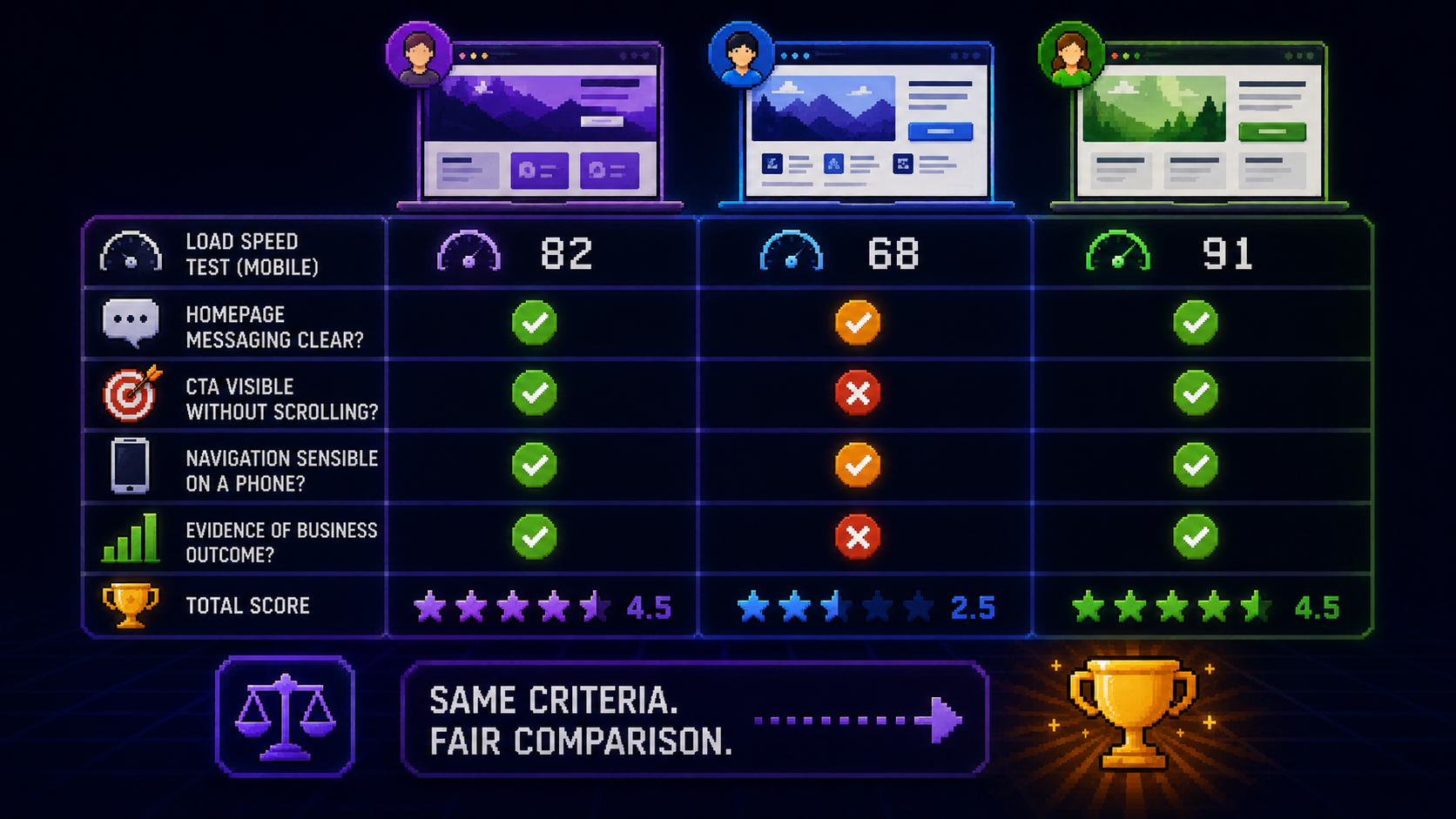
Apply the same checklist to every portfolio you evaluate:
- Load speed test on mobile: score above 70?
- Homepage messaging immediately clear?
- Call to action visible without scrolling?
- Navigation sensible on a phone?
- Evidence of a business outcome, not just a finished design?
Score each designer on the same criteria. The one whose sites consistently perform well across all these dimensions is the one most likely to produce the same results for you.

Frequently Asked Questions