
Almost every business has a website. Almost no business thinks carefully about which type of website they have. And that distinction, between a website built to inform and a website built to convert, explains more about why some sites generate consistent inquiries and others do not than any design decision, any platform choice, or any amount of traffic.
An informational website and a converting website are two fundamentally different products built for two different purposes. A website that informs tells visitors what the business does. A website that converts guides visitors toward becoming clients. Both can look identical from the outside. Their outcomes are entirely different.
The single most common mistake businesses make when commissioning a new website is starting with aesthetics before defining what the website actually needs to achieve. A high-converting website is not a collection of pages. It is a guided journey.
This article explains the specific structural and strategic differences between the two, how to identify which type you currently have, and what needs to change if you have the wrong one.

What an Informational Website Does
What is the difference between an informational and a converting website?
An informational website exists to describe. It tells visitors who the business is, what services are offered, where the business is located, and how to get in touch. It answers the question "what is this?" It is essentially a digital brochure.
Most informational websites have all the right pages: Home, About, Services, Contact. They have professional photography or stock images. They have a list of services, a short company description, and a contact form at the bottom. They look like a legitimate business website because that is exactly what they are.
Many businesses assume that a good-looking website will generate leads. But design does not drive conversions. Strategy does. SEO-friendly website design brings users in. Conversion optimization converts them. The best-performing websites combine both.
The informational website's fundamental failure is that it places the burden of decision-making entirely on the visitor. The visitor arrives, reads the description, forms an opinion, and either decides to reach out or not. The website itself does nothing to guide that decision. It presents. It does not persuade. It informs. It does not convert.
For businesses where clients find them through strong word-of-mouth, referrals, or personal reputation, an informational website is often sufficient. The decision to hire was made before the visitor arrived. The website just needs to confirm credibility.
For businesses that depend on their website to generate new inquiries from people who found them through search, the informational model fails consistently.

What a Converting Website Does Differently
How is a converting website structured differently from an informational one?
A converting website is built around a specific visitor with a specific problem and a specific action you want them to take. Every structural decision, from the headline to the section order to the placement of the call to action, is made in service of guiding that visitor from the moment they land to the moment they reach out.
Every page a visitor lands on should have a clearly defined purpose, and every page should direct the visitor towards the next logical step. This is the principle of intentional information architecture. For service businesses, a typical high-converting path looks like: a landing or service page that communicates value and builds credibility, a social proof section that reinforces trust with case studies or testimonials, a call-to-action or contact section that makes the next step frictionless, and a confirmation page that sets expectations and continues engagement.
The structural differences between the two types of websites are specific and identifiable.
The headline.
An informational website headlines with the business name or a vague positioning statement. A converting website headlines with a specific statement of who it helps and what they get. Not "PixelSeed Studio" or "Creative Digital Solutions" but "We build websites for service businesses that want to be found in AI search and convert the clients they find."
The section order.
An informational website presents services, then about, then contact in whatever order felt logical to the business owner. A converting website structures sections to mirror the psychological journey of a buyer: first capture attention with a specific, relevant headline, then build interest by describing the problem the visitor recognizes, then establish credibility with specific social proof, then make the next step easy with a clear and frictionless call to action.
The calls to action.
An informational website has a "contact us" link in the navigation and a form at the bottom of the contact page. A converting website has a specific, benefit-stated call to action visible above the fold, repeated at natural decision points throughout the page, and on every major page of the site.
The social proof.
An informational website may have a testimonials page that visitors rarely find. A converting website has specific, outcome-referenced testimonials placed strategically near the calls to action they support, where trust is needed most.
The content direction.
An informational website talks about the business. A converting website talks about the visitor. Every sentence can be tested with one question: is this about us, or is this about what the visitor gets?
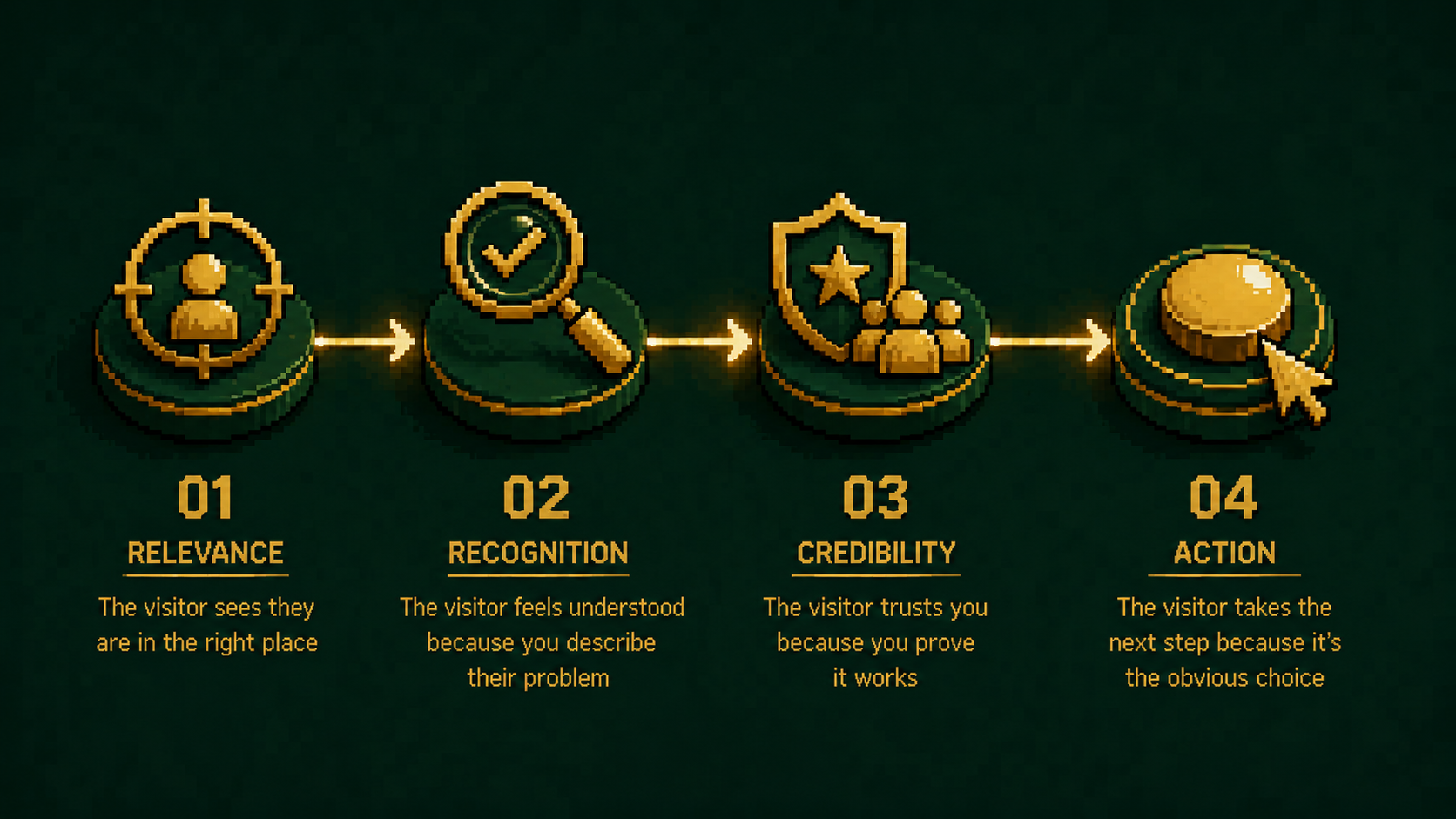
The Psychological Journey a Converting Website Maps
What psychological path does a converting website guide visitors through?
The psychology behind conversions has not changed: people act when they feel informed, confident, and understood. Your website should communicate all three instantly.
A converting website maps a specific psychological journey. It does not happen by accident. It is designed deliberately.
Step 1: Relevance.
The first thing the visitor sees tells them immediately whether this site is for someone like them. A specific headline that names a recognizable type of client and a recognizable problem creates immediate relevance. The visitor thinks "yes, that is me." They stay.
Step 2: Recognition.
The next section of the page describes a problem or situation the visitor recognizes from their own experience. Not in vague terms but in specific language that matches how they would describe the problem themselves. When visitors read their own problem described accurately by someone else, they feel understood. Understanding builds trust faster than any credential.
Step 3: Credibility.
Before asking the visitor to do anything, the converting website provides evidence that it delivers what it promises. Specific testimonials. Case study results. Named clients. A clear process. These elements answer the question "has anyone else done this and did it work?" If the answer is a compelling yes, the visitor is ready to act.
Step 4: Action.
The call to action arrives at the moment the visitor is most ready to take it: after they have recognized the site is for them, understood that the business gets their problem, and seen evidence that the solution works. At that moment, "book a free 30-minute strategy call" is not a hard sell. It is the obvious next step.
Most informational websites skip steps one through three and go directly to step four. They ask for action from a visitor who has not yet been given a reason to trust.
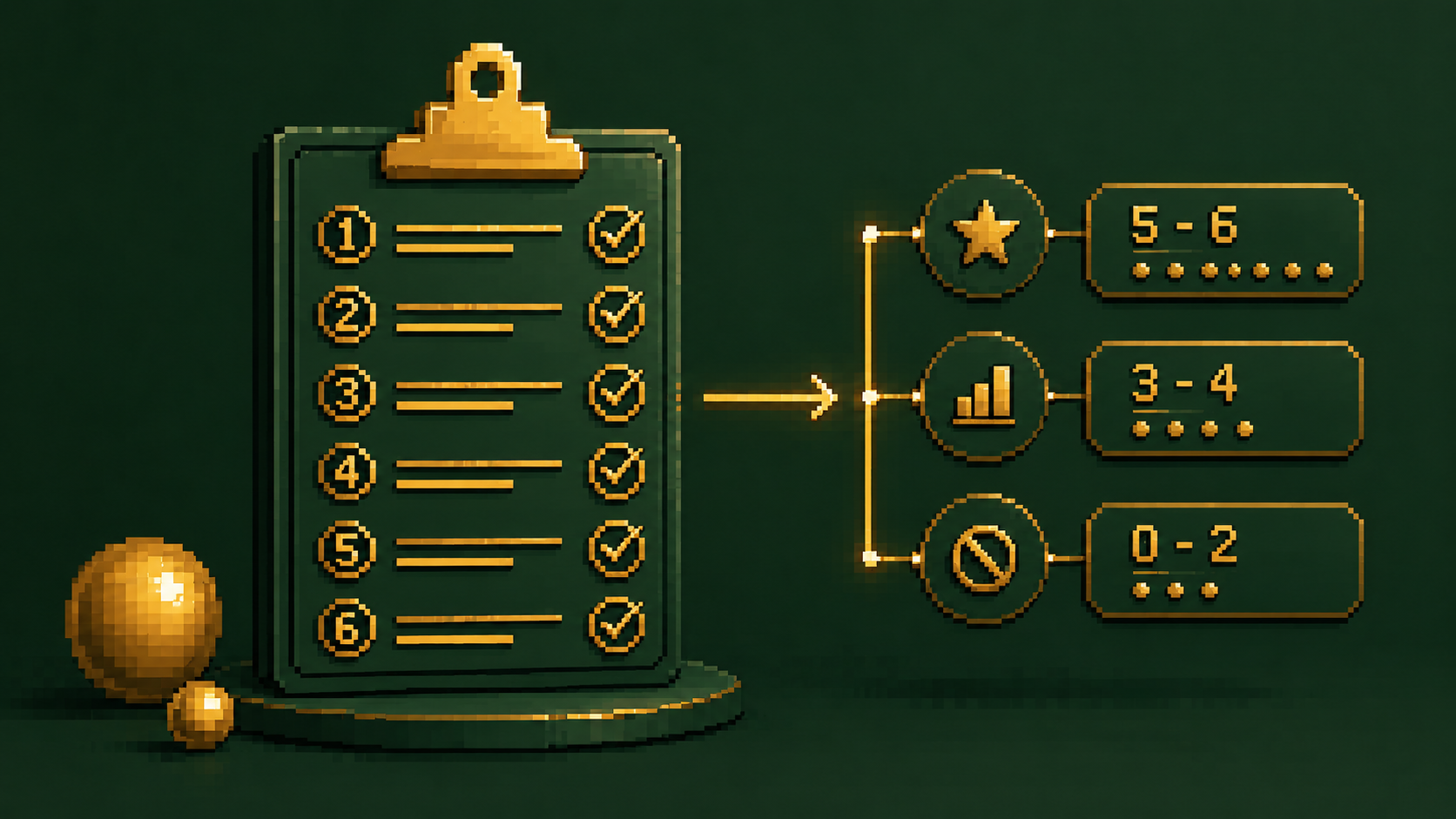
How to Tell Which Type You Currently Have
How do I know if my website is informational or converting?
Run through these six questions honestly. Score one point for each yes.
1. Does your homepage headline name a specific type of client and a specific problem or outcome, rather than your company name or a vague positioning statement?
2. Is there a specific, benefit-stated call to action visible without scrolling on your homepage on mobile?
3. Do you have at least two specific, outcome-referenced testimonials visible on your homepage without scrolling?
4. Does your services page describe what clients get and how their situation changes, rather than listing your service features?
5. Does your About page include a photo of a real person, their name, and a specific reason why they do this work, rather than a company history or a resumé?
6. Is every major paragraph on your homepage about what the visitor experiences and gets, rather than about your business's credentials and history?
Score 5 to 6:
Your website is primarily a converting website. Focus on optimizing specific elements and building traffic.
Score 3 to 4:
Your website has converting elements mixed with informational elements. Targeted rewrites of the lowest-scoring items will produce measurable improvement.
Score 0 to 2:
Your website is primarily informational. It may look professional, but it is not doing conversion work. The gap between what it could generate and what it is generating is significant.

What It Takes to Convert an Informational Website
Can I turn my informational website into a converting one without a full rebuild?
Usually yes, and faster than most business owners expect. The conversion problems that most informational websites have are surface-layer problems: messaging, structure, and trust signals. None of these require rebuilding the site from scratch.
The changes that produce the highest impact in the shortest time are almost always the same: rewriting the homepage headline to be specific and visitor-focused, adding specific outcome-referenced testimonials near the primary call to action, repositioning the call to action above the fold, restructuring the services page around outcomes rather than features, and adding a human photo and specific story to the About page.
These changes can typically be made in a few days on an existing site with CMS access. They do not require a new design. They require the strategic thinking that should have been applied when the site was first built.
The exception is when the informational structure is so deeply embedded in the site's architecture that working around it costs more than rebuilding with the right architecture from the start. This is less common than most agencies suggest but more common than most business owners want to hear. The diagnostic audit is what determines which situation you are in.

Frequently Asked Questions