
Of the four layers of AI visibility, AIO is the least understood, the least talked about, and the most frequently neglected. It is also, in many cases, the missing piece that explains why a business with good content and proper schema markup still fails to appear consistently in AI recommendations.
AIO, AI Indexing Optimization, refers to building the cumulative off-site trust signals including reviews, citations, brand mentions, and cross-platform presence that make AI systems confident enough to recommend your brand. GEO earns citations through content structure. AIO earns trust through reputation signals built across the broader web.
The core insight of AIO is that AI tools do not only read your website. They read everything on the internet that mentions your business. And when the picture they get from all those sources is consistent, specific, and credible, their confidence in recommending you increases significantly. When it is inconsistent, outdated, or sparse, their confidence drops regardless of how well your website is structured.

What AIO Actually Addresses
What is AI Indexing Optimization in plain language?
AIO sets the foundation: your site and brand are clear, consistent, and credible. AEO makes your answers extractable: the best parts of your pages are easy to pull and quote. GEO earns the summary mention: your content gets synthesized and referenced. AIO is not a one-time project. It is a discipline.
The platforms AI tools read alongside your website include your Google Business Profile, your LinkedIn company page, your profiles on industry directories, review platforms like Google Reviews, any press mentions or industry publications that reference your business, Reddit threads and community discussions that mention your category, and any other publicly accessible source where your business name appears.
When all of these sources agree on who your business is, what it does, where it is located, and what category it belongs to, AI tools see a coherent entity they can trust and recommend. When these sources contradict each other, contain outdated information, or barely mention your business at all, AI tools see an unclear, low-authority entity and look for better-established competitors to recommend instead.

The Entity Consistency Problem
Why does inconsistent business information hurt AI visibility?
Conflating entity consistency with repetition: using consistent brand language across platforms is essential for AI models to build a coherent picture of who you are. AI models are trained on natural language and are increasingly good at identifying content written to manipulate rather than inform. The goal is recognizable, consistent entity signals, not density.
Entity consistency means your business name, address, phone number, service descriptions, founding story, and category appear identically across every platform that lists your business. Not approximately the same. Identically.
Here is why this matters at the technical level. AI tools build knowledge graphs of entities: businesses, people, places, and concepts. When an AI tool encounters your business name, it looks for every other mention of that name across its indexed sources to build a complete picture. If it finds your business listed as "PixelSeed" in one place, "PixelSeed Studio" in another, and "The Pixel Seed" in a third, it sees three potentially different entities. Its confidence in any single one is reduced. The entity model it builds is fragmented rather than clear.
Semantic clarity means AI does not just read words; it understands concepts, entities, and the relationships between them. AIO emphasizes clear, unambiguous phrasing and deep, authoritative coverage of a topic, proving to the AI that you are the expert on that concept cluster.

The Five Platforms AIO Starts With
Where should I focus my AIO efforts first?
For a service business, these five platforms have the highest weight in AI entity evaluation and should be the starting point for any AIO audit.
Google Business Profile.
This is the single most influential off-site signal for local and regional service businesses in AI search. Google's Gemini model uses Google Business Profile data heavily for local recommendations. A complete, accurate, regularly updated Google Business Profile with the correct business category, a specific service description, recent photos, and active review management is one of the highest-impact AIO actions available.
LinkedIn company page.
AI tools including ChatGPT read LinkedIn as a credible source for business entity verification. Your LinkedIn company page should use exactly the same business name, description, and service terminology as your website. The founding date, service categories, and about section should be consistent with every other platform.
Industry directories.
Directories relevant to your category, whether they are general business directories or industry-specific listings, provide the citation breadth that AI tools use to verify your business across multiple independent sources. Appearing in five to ten relevant directories with consistent, complete information strengthens your entity model significantly.
Review platforms.
AI systems use reviews as a filter, not just a ranking factor. If your ratings do not cross a certain threshold, you may be filtered out of recommendations regardless of your other signals. Active, recent reviews on Google and relevant third-party review platforms signal to AI tools that your business is actively serving clients and that those clients are willing to publicly endorse you. Review recency matters as much as review count.
Your own website.
AIO is primarily an off-site discipline, but your website's own entity signals anchor the entire system. The Organization schema on your homepage, the About page content, your contact page, and any author profile pages all contribute to the entity model AI tools build.
The AIO Audit: What to Check and Fix
How do I audit my current AIO status?
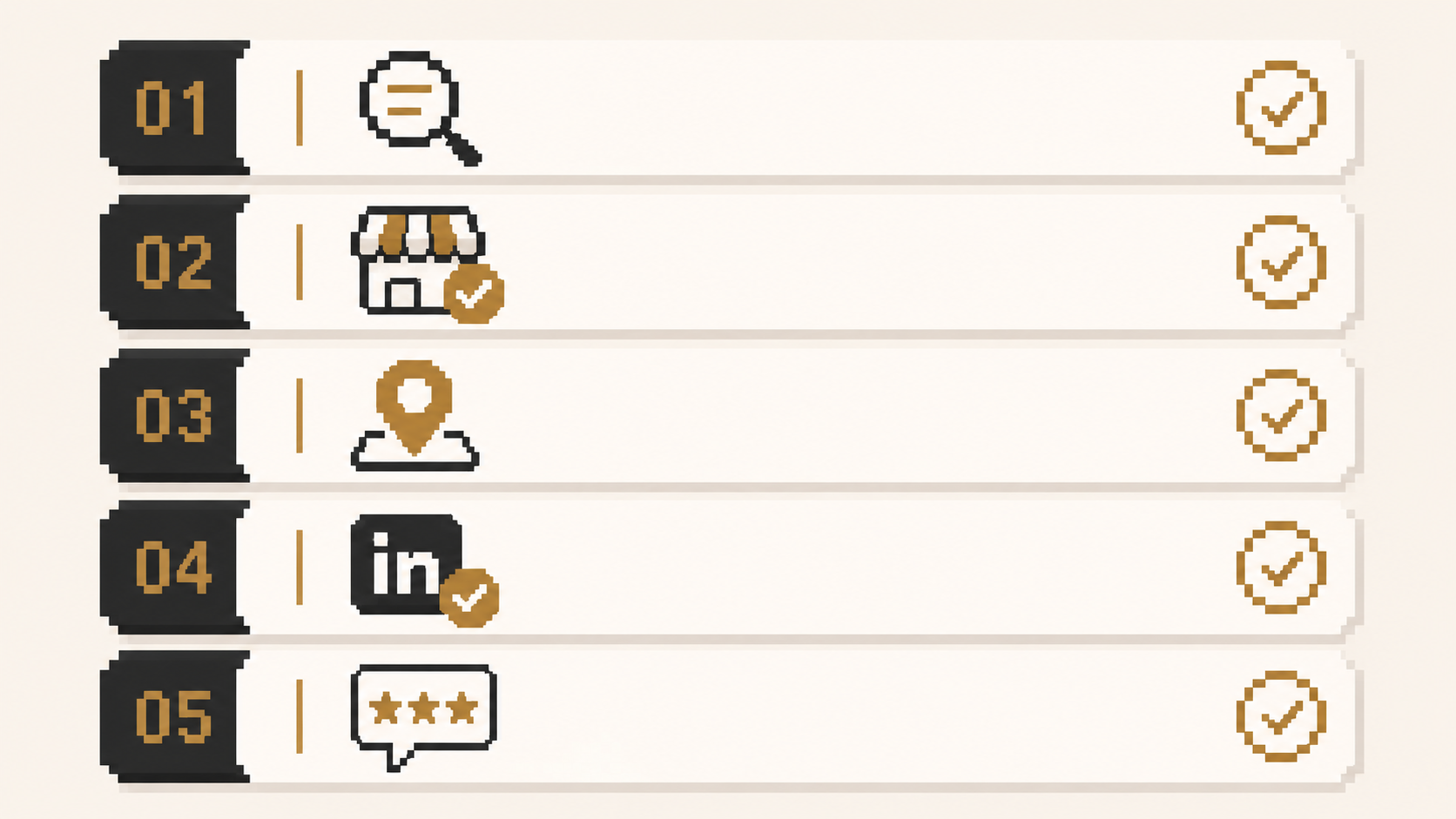
Work through these five checks systematically. Each one is something you can verify yourself in under five minutes.
Check 1: Name consistency
Search your business name in Google. Look at the first ten results. How many different versions of your business name appear? If you see variations, identify the exact official name you want to use everywhere and begin correcting inconsistencies starting with the highest-traffic platforms.
Check 2: Google Business Profile completeness
Open your Google Business Profile. Confirm: is your business category accurate and specific? Is your description complete, specific, and consistent with your website? Do you have a full service list? Have you posted in the last thirty days? Do you have at least ten recent reviews? Any no is a priority fix.
Check 3: NAP consistency
NAP stands for Name, Address, Phone number. Search your business name alongside your city in Google. Look at every directory listing that appears. Compare the business name, address, and phone number across each one. Any variation is an inconsistency to fix.
Check 4: LinkedIn alignment
Visit your LinkedIn company page. Compare the company name, description, industry category, and service descriptions against your website. They should use the same language and present the same business. Any significant divergence is worth correcting.
Check 5: Review recency
Look at the most recent reviews on your Google Business Profile. When was the last one? If the most recent review is more than ninety days old, review velocity is a gap. AI tools favor businesses with active, ongoing review activity over those with a static review history.

Building AIO Over Time
How do I build AI Indexing Optimization consistently?
AIO is a compound investment. Each individual action adds a small amount to your entity authority. Consistent action over months produces a meaningfully stronger entity model than a burst of activity followed by neglect.
The sustainable AIO maintenance routine for a service business involves four ongoing practices.
Claim and complete new relevant directory listings as you discover them.
New directories appear regularly. Industry-specific directories that your competitors appear in and you do not represent both an AIO gap and an opportunity.
Ask clients for reviews on a consistent basis.
A reliable process for requesting reviews from satisfied clients, whether through a post-project email, a follow-up conversation, or an automated request, produces steady review velocity that signals ongoing active business to AI tools.
Keep your Google Business Profile updated.
Post regular updates, add new photos, respond to all reviews (positive and negative), and update your service descriptions whenever your offering evolves. An active Google Business Profile is treated significantly differently from a dormant one by AI tools.
Monitor for incorrect or outdated listings.
As your business evolves, old information persists in directories and across the web. Annual audits of your digital footprint, searching your business name and correcting any incorrect or outdated listings you find, maintain the consistency that AIO requires.

Frequently Asked Questions