Something has changed in how people find businesses, and most business owners have not noticed yet.
Two years ago, if someone wanted to find a web designer, a consultant, an accountant, or a service provider of any kind, they opened Google. They got a page of ten blue links. They clicked two or three, compared, and decided.
That process is not disappearing. But it is no longer the only process. And for a growing number of buyers, it is no longer the first one.
Today, a buyer looking for a service provider might open ChatGPT and type "who builds good websites for small businesses?" They might ask Perplexity "what should I look for in a web design agency?" They might ask Google's AI Overviews to summarize the best options in their category. And instead of ten links to scroll through, they get one or two direct recommendations.
If your business is one of those recommendations, you are in the conversation. If it is not, you do not exist for that buyer. They never see your name. They never visit your site. They go with whoever the AI told them to consider.
ChatGPT recommends only 1.2% of local businesses, whereas Google's local results show 35.9% of locations. That gap is not a minor statistical difference. It is the difference between being found and being invisible to an entirely new category of buyer.
This guide is the complete plain-language explanation of what AI visibility is, why it matters for your business right now, what the four layers of it mean in practice, and what a realistic path to being recommended by AI tools actually looks like.
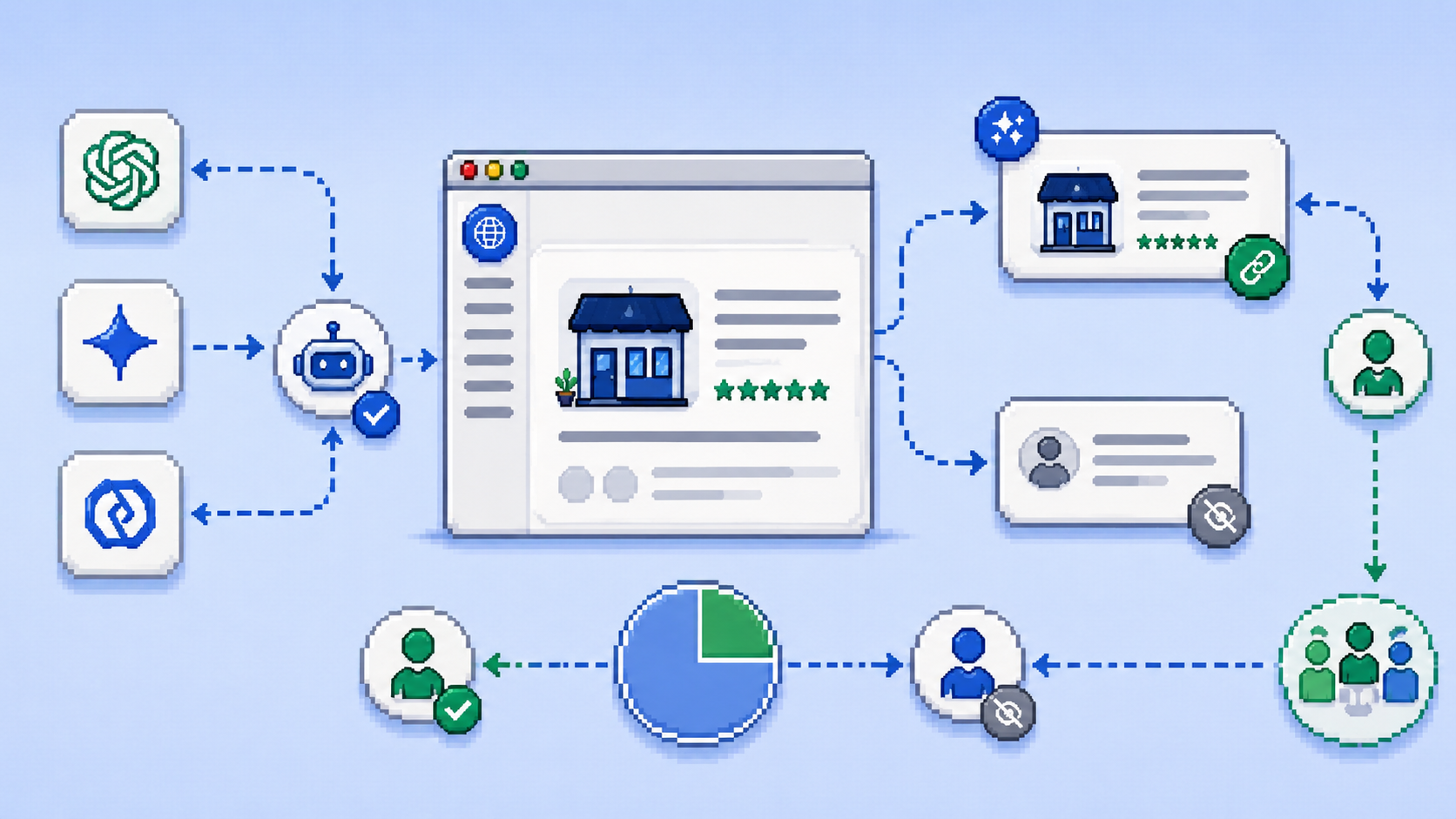
What AI Visibility Actually Is
What is AI visibility for a business website?
AI visibility is the measure of whether AI tools like ChatGPT, Gemini, and Perplexity recognize, trust, and recommend your business when a potential client asks about your category. It is entirely separate from Google rankings and requires a different strategy to earn.
AI visibility encompasses every instance where an AI platform cites your content, mentions your brand name, or recommends your business when a user asks a relevant question.
There are two levels of AI visibility worth understanding. The first is being mentioned. The AI knows your business exists and includes your name somewhere in a response. The second, more valuable level, is being cited. The AI links directly to your website as a trusted source and recommends your business specifically. Being mentioned signals awareness. Being cited signals authority. The goal is citation.
Only 18% of brands have an active AI visibility strategy. The other 82% are invisible by default and they do not know it because the metrics they report on do not measure it.
That invisibility has real consequences. Not because AI search is replacing Google, but because it is running alongside it, serving a buyer type that is increasingly common, increasingly high-intent, and increasingly likely to make a decision based on what the AI tells them before they ever visit a website.

Why This Matters More Than Most Business Owners Realize
Why does AI search visibility matter for my business?
The scale of the shift is the first reason it matters.
ChatGPT serves 800 million users weekly. AI-referred traffic to the top 1,000 websites grew 357% year-over-year, reaching 1.13 billion visits in June 2025.
73% of B2B buyers now use AI tools like ChatGPT and Perplexity in their research process. This is not a niche behavior among early adopters. It is the majority of buyers in many categories, including the service businesses that The PixelSeed Studio works with.
The quality of that traffic is the second reason it matters.
AI search traffic converts at 14.2% compared to Google organic's 2.8%, a 5.1x advantage. Buyers who arrive at your website through an AI citation are not at the beginning of their research. They have already had their questions answered by the AI tool. They have already made a preliminary decision to consider your business. They arrive with intent, not curiosity.
The competitive timing is the third reason it matters.
AI visibility is still in its early stages, which means you are not late to the game. You are actually early. Most businesses have not even started tracking their AI mentions, let alone optimizing for them. This creates a genuine first-mover advantage for those who act now.
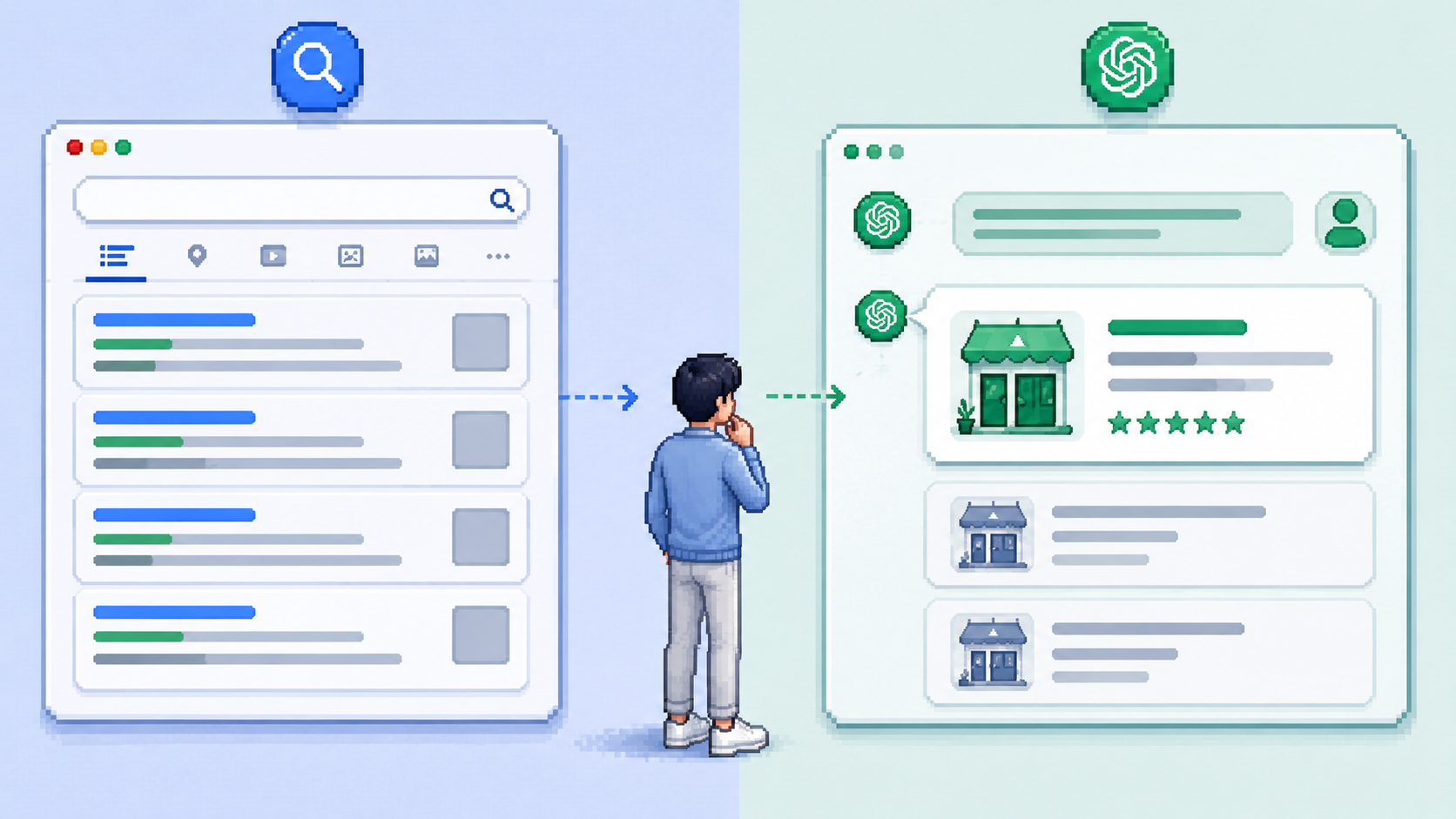
How AI Search Is Different From Google
What is the difference between AI search and Google search?
Google returns a list. When you search on Google, you get a page of results, typically ten links, ranked by relevance and authority. The user decides which ones to click. Multiple businesses appear. Multiple businesses get a chance.
AI search returns a recommendation. When you ask ChatGPT, Perplexity, or Gemini a question about which business to hire or which service to use, the AI synthesizes everything it knows and gives you one or two specific answers. Not a list to choose from. A recommendation to act on.
Google's AI Overviews now appear in 18% of all Google searches and in 57% of long-tail queries. Across all Google searches, 43% now end without any click to an external website, a figure that rises to 93% when Google's AI Mode is active.
Strong Google performance does not predict AI visibility. The criteria are different. The sources are different. The structure that earns you a featured snippet on Google is related to but not identical to what earns you a citation in ChatGPT. And the businesses currently winning AI citations are not necessarily the same ones ranking at the top of Google.
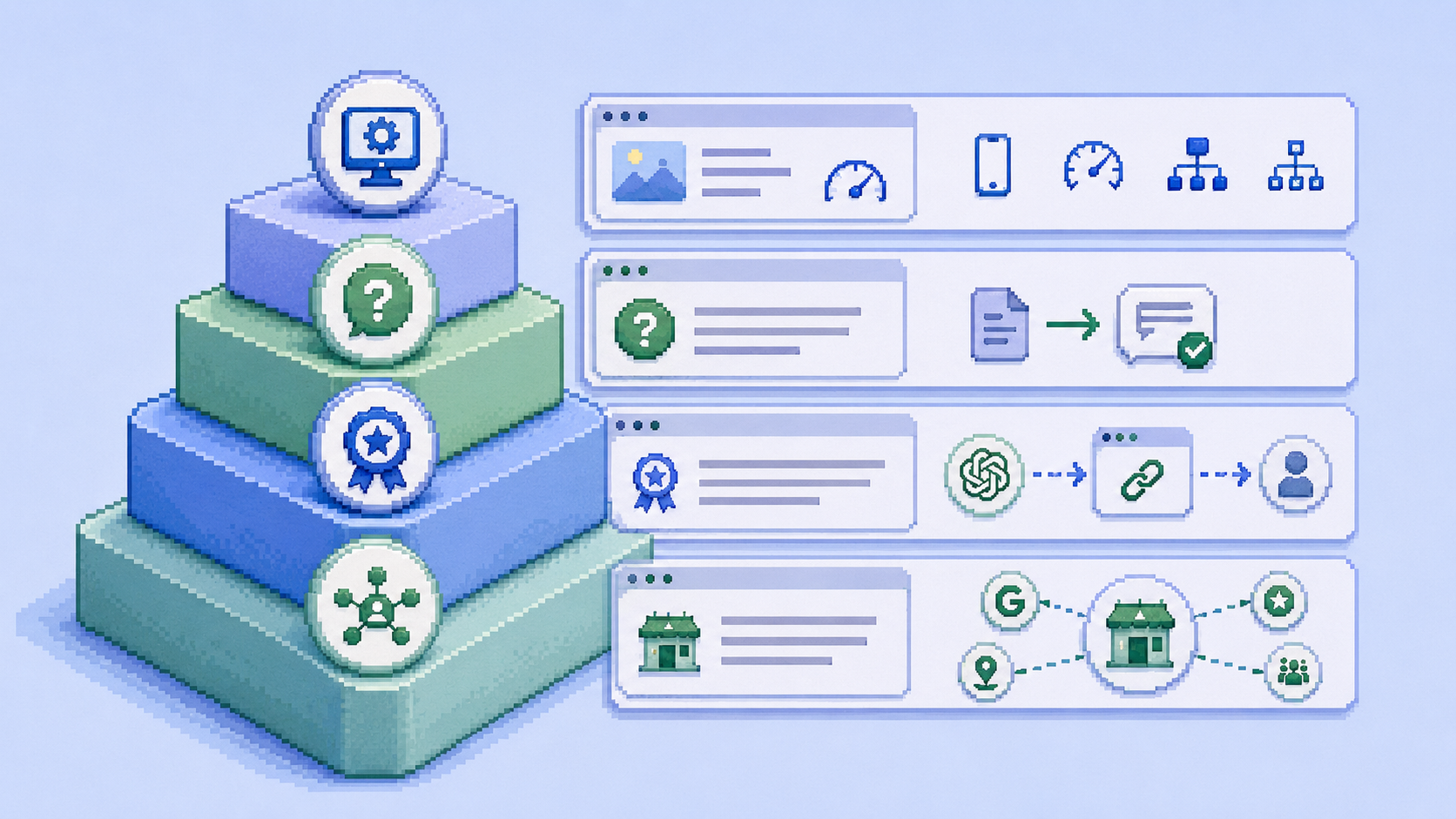
The Four Layers of AI Visibility
What are AEO, GEO, and AIO and do I need all of them?
AI visibility is not one thing. It is four distinct layers, each addressing a different part of how your business gets found, understood, and recommended by AI tools.
Layer 1: SEO, the Foundation
SEO is the technical foundation that makes your website readable and rankable by search engines. Without it, nothing else works. Fast load times. Mobile-first design. Clean heading structure. Proper meta titles and descriptions. An XML sitemap. These are not optional extras. They are the baseline that allows Google and AI tools alike to read, understand, and index your website. SEO is the floor, not the ceiling.
Layer 2: AEO, Answer Engine Optimization
AEO is the practice of writing content structured so that AI tools can extract a complete, direct answer from a single paragraph or section without needing the surrounding context. Every major section answers one specific question directly. The answer appears in the first sentence of the section. The answer is complete enough to make sense without surrounding context.
Layer 3: GEO, Generative Engine Optimization
GEO is the practice of writing content so specific and authoritative that AI tools cite your website by name as the source of an answer, not just index it. There is a meaningful difference between being indexed and being cited. An AI tool that has indexed your website knows you exist. An AI tool that cites your website by name in a response is recommending you to a buyer.
Layer 4: AIO, AI Indexing Optimization
AIO is the practice of making your business a consistent, recognizable entity across every platform AI tools read, so that every system that indexes the internet sees the same clear, credible business and trusts it enough to recommend it. AI tools read your Google Business Profile, LinkedIn, directories, review platforms, and anywhere your business appears alongside your website.
What AI Visibility Looks Like in Practice
How do I know if my business has AI visibility?
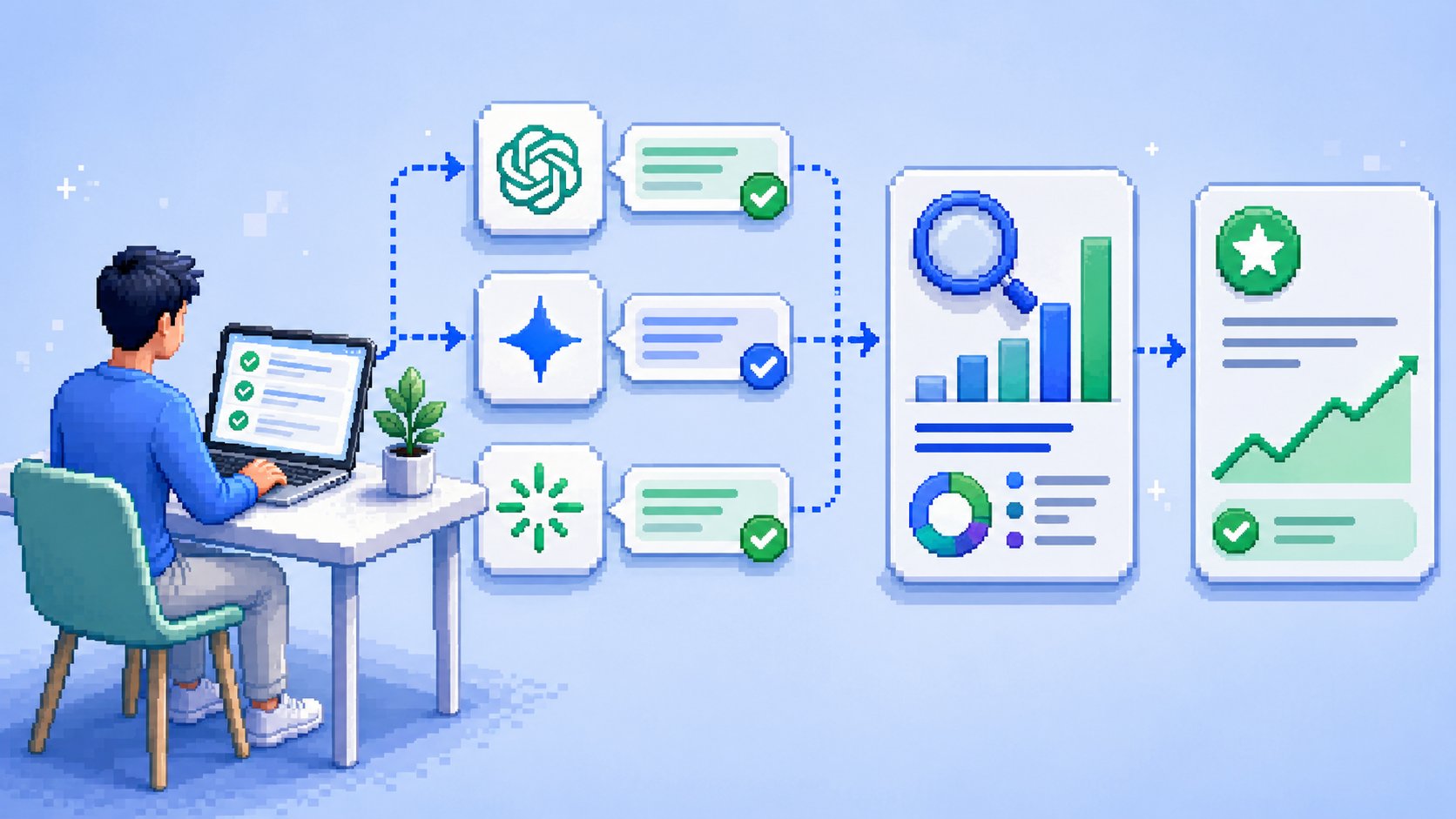
The simplest check is also the most honest one. Open ChatGPT, Perplexity, and Gemini. Type five questions that your ideal clients might ask when looking for a business like yours. Record what comes back. Is your business cited by name? Mentioned indirectly? Is a competitor recommended instead of you?
ChatGPT recommended only 1.2% of locations in a January 2026 SOCi study analyzing the visibility of nearly 350,000 business locations. Gemini recommended 11% of locations. Perplexity recommended 7.4% of locations. For comparison, Google's local results featured 35.9% of locations.
If you run this check and discover your business does not appear, you are in the majority. That is not reassuring. It is an opportunity.
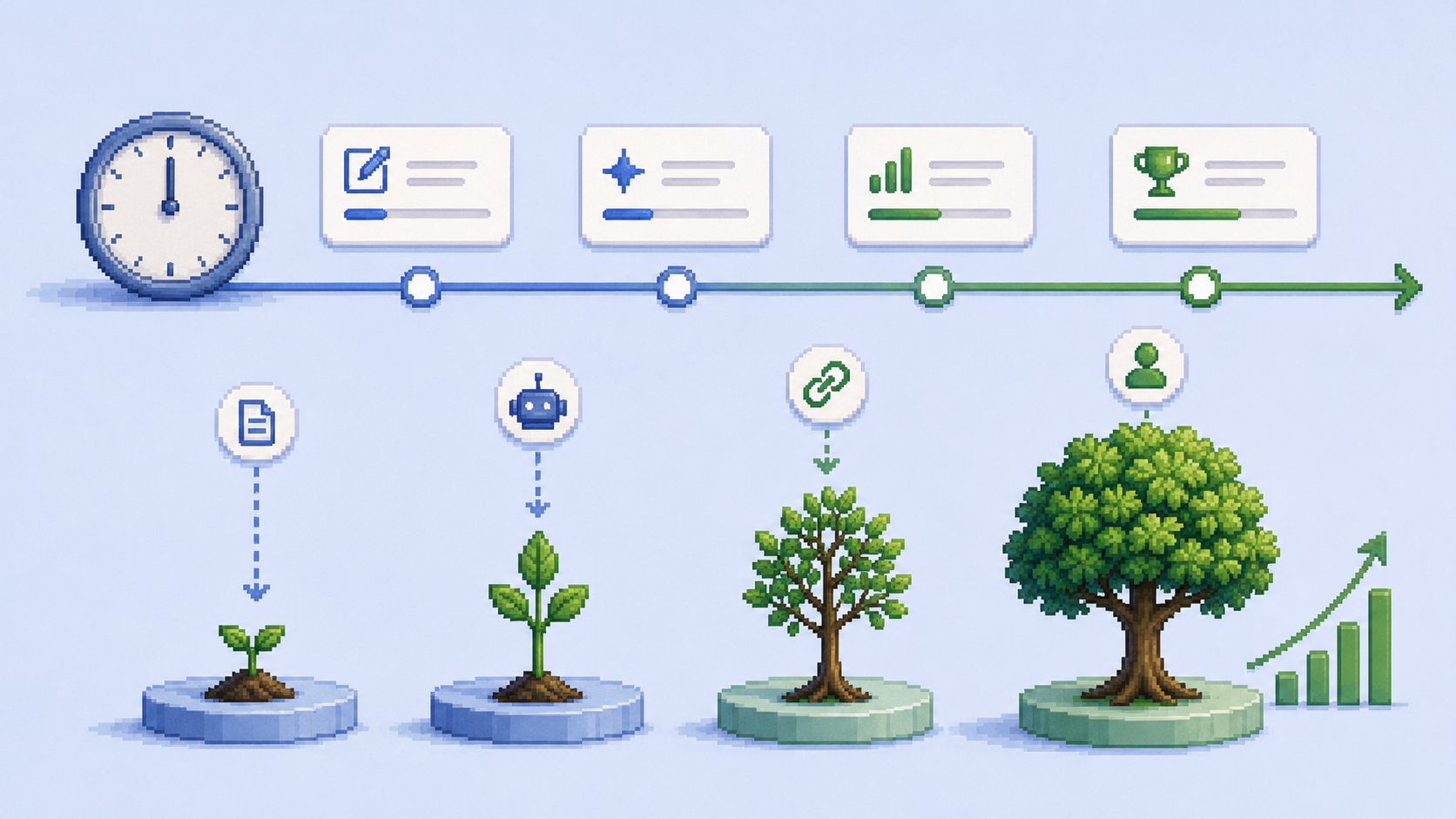
The Realistic Timeline
How long does it take to build AI visibility?
Results from AI visibility strategies typically emerge over a four-to-six-month timeline, with early wins appearing within eight to twelve weeks for businesses that implement the framework consistently.
New AEO-optimized content achieves first AI citations within three to five business days of publication, with measurable improvements in overall mention rates appearing within two to three weeks of systematic AEO implementation.
The businesses that start now have a meaningful advantage over those that start in six months, because AI tools build their understanding of your brand over time.
Where to Start
What is the first step to improving my AI visibility?
Start with the audit. Before optimizing anything, understand where you stand. Run the ten-minute check described above across ChatGPT, Perplexity, and Gemini. Record exactly what appears.
At The PixelSeed Studio, the free AI Visibility Audit we offer diagnoses exactly which of these problems applies to your specific website and business, and maps out the specific changes that would move you from invisible to recommended. It takes 48 hours and gives you a plain-English picture of exactly where you stand and what needs to change.

Frequently Asked Questions