
Most businesses treat SEO content and AI visibility content as two separate problems requiring two separate strategies. One team works on ranking articles. Another team works on AI-optimized content. The effort duplicates. The investment doubles.
This separation is a mistake based on a misunderstanding. SEO rankings and AI visibility are not built by different content strategies. They are built by the same content strategy, executed with the right architecture.
SEO and AI visibility are not competing priorities. They are complementary disciplines that, when combined into a unified strategy, reinforce each other in powerful ways. Strong SEO creates the crawlable, authoritative content that feeds AI models. AI visibility optimization shapes how that content is written and structured so it gets cited and recommended. Together, they form the new playbook for organic growth.
The PixelSeed Studio blog you are reading right now is a live demonstration of this strategy. Every article is structured to earn Google rankings and AI citations simultaneously. The same content structure that earns featured snippets earns AI citations. The same topical authority that signals expertise to Google signals expertise to AI tools. One investment. Both channels.
This article explains exactly what that unified strategy looks like and how any service business can implement it.

The Architecture That Serves Both Channels
What content structure earns both Google rankings and AI citations?
The pillar and cluster architecture serves both channels simultaneously because it satisfies the requirements of both systems.
Google rewards topical authority, demonstrated through a content ecosystem where multiple interconnected articles cover a subject comprehensively. The pillar and cluster model is specifically designed to build topical authority.
AI tools reward content depth and specificity on a consistent topic, demonstrated through a body of work where every article answers specific questions with direct, extractable answers. The pillar and cluster model, when each article is written with question-format headings and answer-block structure, is specifically designed to produce the content AI tools prefer to cite.
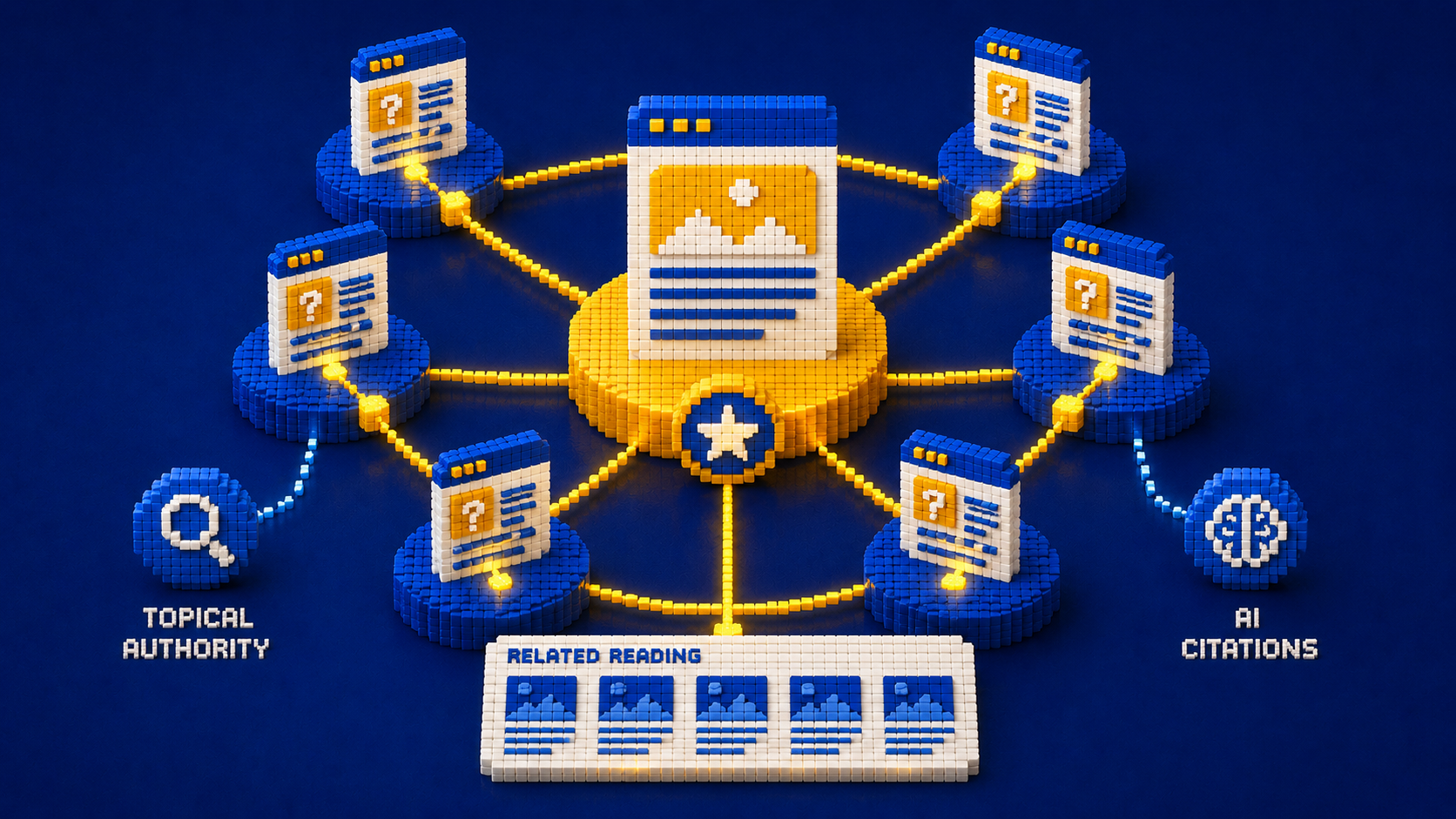
A topic cluster consists of three elements: a pillar page covering a broad topic comprehensively, a set of cluster pages covering specific subtopics in depth, and a clear internal linking structure connecting all cluster pages. Every cluster article links back to the pillar page and to two to four topically related cluster articles. Internal linking is the technical mechanism through which topical authority is communicated to Google.
The result is a content system where every piece of content strengthens every other piece, where the internal link architecture builds authority for the pillar pages, where each cluster article earns both topical authority signals for Google and extractable answer citations for AI tools, and where the combined output is greater than the sum of its parts.

How Article Structure Serves Both Channels
How do I write an article that ranks on Google and gets cited by AI tools?
Every article that serves both channels follows the same structural pattern at the section level.
H2 heading phrased as a question.
The question format signals to Google that this section addresses a specific informational query and makes the section eligible for featured snippet extraction. The same question format signals to AI tools that this section contains a question-and-answer pair ready for extraction.
First sentence as the complete answer.
A 40 to 60 word answer that is complete and standalone satisfies both Google's snippet extraction criteria and AI tools' citation extraction criteria. The same sentence earns both.
Supporting paragraphs with specific data.
Specific statistics and verifiable claims, cited with sources in the same sentence, satisfy both Google's E-E-A-T quality signals and AI tools' GEO (Generative Engine Optimization) citation criteria. The same data point serves both audiences.
FAQ section at the end.
A FAQ section with FAQPage schema markup earns featured snippet consideration from Google and structured question-and-answer citation eligibility from AI tools. The same section serves both.
The structural pattern that earns a snippet is the same pattern that earns a citation in an Overview, in ChatGPT, in Perplexity, or in Gemini. Writing for the snippet now writes for all three citation surfaces at once.

The Editorial Process That Makes It Systematic
How do I make this content strategy consistent across every article?
The content strategy that serves both channels consistently is built on a repeatable editorial process rather than on individual inspiration.
Step 1: Topic selection from real buyer questions.
Every article topic is a question that real buyers search for at a specific stage of their decision process. Not a topic the business wants to be associated with. A question that buyers actually type. The source for these questions is Google Search Console queries, People Also Ask boxes, sales call notes, and support interactions.
Step 2: Cluster mapping before writing.
Before writing any article, identify where it fits in the pillar and cluster architecture. Which pillar does it support? Which cluster articles will it link to? This mapping ensures every article is planned for topical authority contribution rather than written in isolation.
Step 3: Question-format outline.
Every major section of the article is outlined as a question the section will answer. This forces the section heading to be a question and ensures the first paragraph answers it directly. The outline becomes the AEO structure before a word of prose is written.
Step 4: Data sourcing before writing.
Before writing any section, identify the specific statistics, research findings, or verifiable claims that will be cited within it. Specific data is cited in the same sentence it appears. This satisfies GEO requirements before the prose is drafted.
Step 5: FAQ section as the final element.
Every article ends with a FAQ section of five to ten questions addressing the topic from additional angles not covered in the main content. These questions are sourced from the same buyer question research used for topic selection. The FAQ is written last and validated against the 40 to 80 word answer length guideline before publication.
How PixelSeed's Own Blog Demonstrates This Strategy
Is the content strategy in this article demonstrated by The PixelSeed Studio's own blog?
Yes. The entire blog content system you are reading is built on this strategy. Every article you read on this blog was written following the process described above.
The pillar pages (the comprehensive overview articles on web design, hiring, pricing, AI visibility, website failure, platform choice, and SEO) are the anchor points of the topical authority structure. The cluster articles each go deep on one specific subtopic, linked to their pillar and to sibling clusters. The bridge articles connect topic areas for readers crossing between pillars.
Every article has question-format H2 headings. Every section leads with a complete answer in the first sentence. Every FAQ section addresses additional buyer questions with answers in the 40 to 80 word range. Every article has a related reading section that implements the internal linking architecture.
The result is a content system where every article strengthens every other article, where every article earns topical authority signals for Google and citation eligibility for AI tools, and where a business owner reading any article is naturally guided toward the adjacent articles that address their next question.
This is the content strategy that The PixelSeed Studio implements for clients. Not as a theory. As a demonstrated, working system that we use ourselves.

Frequently Asked Questions