
A FAQ page on most business websites is an afterthought. It is a list of questions the business thinks clients might ask, written with the answers the business wants to give, formatted in whatever way seemed reasonable when the page was built.
That approach produces a FAQ page that satisfies visitors looking for basic information. It does not produce a FAQ page that AI tools cite.
Websites with optimized FAQ content get three to seven times more AI citations than those without FAQ. Properly written FAQ dramatically increases AI visibility.
The difference between a FAQ page that AI tools cite and one they ignore is specific and structural. It is not about the length of the answers, the number of questions, or the visual design. It is about whether every question-and-answer pair is structured to give AI tools exactly what they need to extract and attribute an answer.
This article explains exactly what that structure is, how to choose the right questions, and how to implement the technical layer that makes AI tools recognize your FAQ content as citable.

The Structure AI Tools Prefer
How should I format FAQ answers for AI search visibility?
FAQ answers of 40 to 80 words get cited most often by AI engines. Shorter answers under 40 words feel insufficient. Longer answers over 80 words get cut off or ignored. AI engines want the answer directly. No introduction, no background. Just the answer first. Any context comes after.
This 40 to 80 word guideline is the most important single piece of information in this article. AI tools extract at the paragraph level. An answer that opens with context, background, or preamble before reaching the actual answer is an answer the AI tool cannot cleanly extract. An answer that leads with the complete response in the first sentence, supported by one or two additional sentences of context, is an answer the AI tool can extract and attribute confidently.
The structural formula for every FAQ answer:
The question is phrased using natural language that matches how a real buyer would type or ask it. Not "What is our refund policy" but "Can I get a refund if I am not satisfied?" Not "How does pricing work" but "How much does a website cost for a small business?"
The first sentence is the complete answer. Complete means it makes sense on its own without reading the question or any additional context. A buyer who reads only this sentence gets the answer they were looking for.
The following one or two sentences add supporting context, qualification, or explanation that helps human readers understand the answer more fully.
Each answer should stand alone so AI Overviews or featured snippets can lift it directly without losing context.

How to Choose the Right Questions
Which questions should I include in my FAQ page?
Source questions directly from real customer interactions in your support tickets, chat logs, and sales calls. Using the exact language your customers use ensures your content matches their high-intent queries and turns those questions into conversion opportunities.
This instruction is the most important guidance for question selection. The questions that your ideal clients actually ask in conversations, in emails, and in sales calls are the questions AI tools are most likely to be asked. When your FAQ contains direct answers to those questions, using the same language your clients use, your page becomes the ideal source for AI tools answering that query.
The four most reliable sources for FAQ questions:
Sales call notes and pre-sale emails.
Every question a prospective client asks before hiring you is a question the next prospective client will also ask. Collect these systematically.
Google Search Console queries.
The queries listed in Search Console that are bringing visitors to your service pages are real questions real buyers are asking. Many of them are natural FAQ questions.
People Also Ask boxes in Google.
Search for your primary service and look at the PAA boxes that appear. Each question in a PAA box is a question real buyers are asking that Google has identified as worthy of a featured answer.
Support interactions after the sale.
Questions clients ask after becoming clients often reveal gaps in how well your pre-sale content explains what to expect. These questions are also questions prospective clients have but may not ask.

What Questions to Avoid
What kind of FAQ questions do not help with AI visibility?
Prioritize high-value questions. Do not pad your FAQ with obvious or low-intent questions just to hit a number. Focus on questions that address real confusion, common objections, or next-level concerns that your main content did not fully cover. Quality over quantity.
The questions that do not earn AI citations are:
Questions nobody actually searches for.
"Do you love what you do?" and "What makes your team special?" are not questions buyers type into ChatGPT or Google. They are questions designed to make the business look good rather than to answer what buyers actually want to know.
Questions already fully answered in the main content.
If your services page already explains your process in detail, a FAQ that repeats the same information adds no value for AI citation purposes. The FAQ should address distinct questions, not summarize content that exists elsewhere on the page.
Questions with answers that are too short.
"Do you serve international clients? Yes." does not meet the 40-word threshold for AI citation and contributes nothing to the page's depth signals.
The Technical Layer: FAQ Schema
Do I need to add schema markup to my FAQ page for AI visibility?
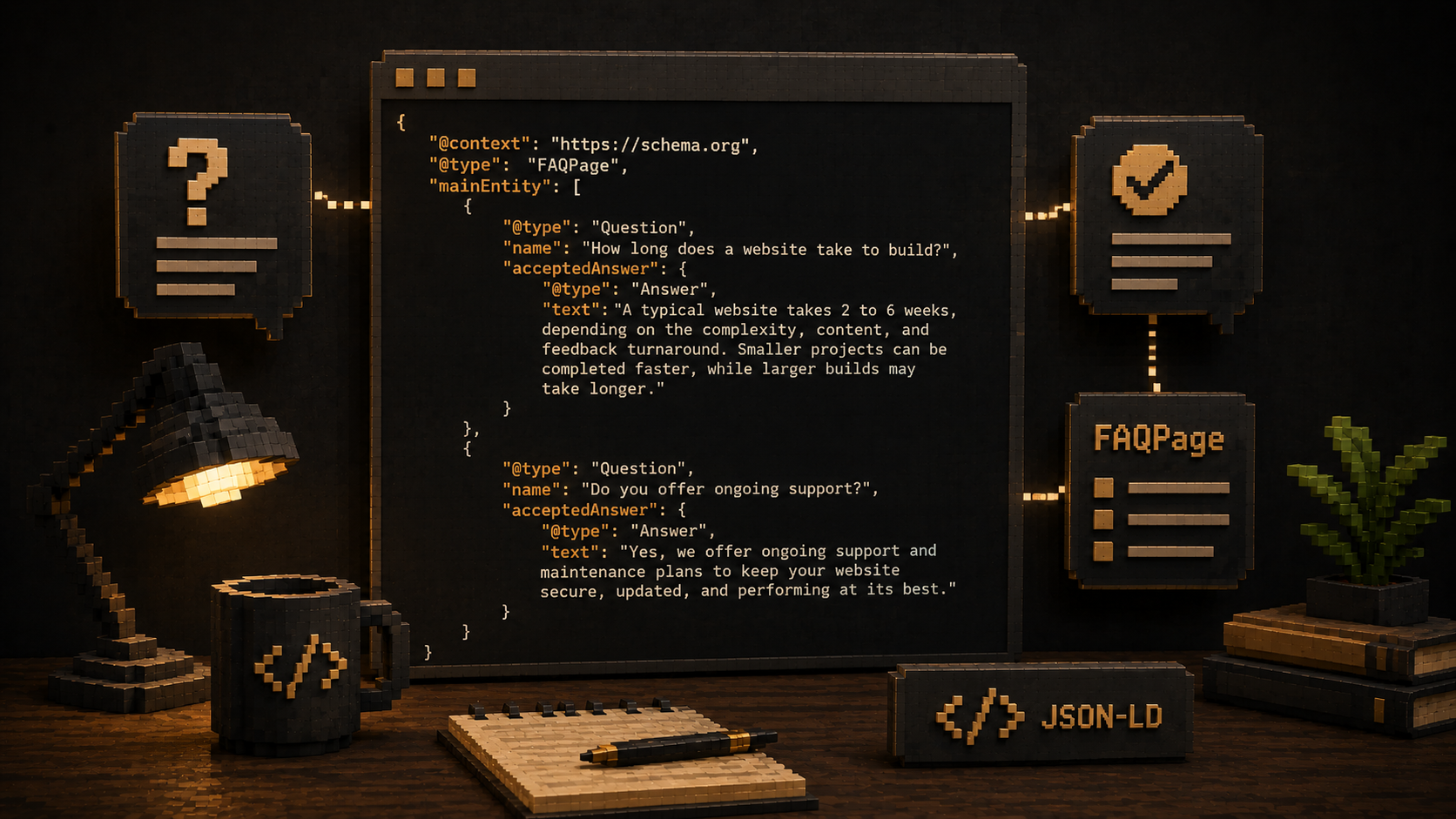
Use FAQPage schema markup. This is non-negotiable for AEO. FAQPage schema explicitly tells answer engines this is a question and this is the accepted answer. It is one of the clearest structural signals you can send. Make sure each question-and-answer pair is properly marked up.
FAQ schema is the machine-readable layer that tells AI tools and search engines that specific sections of your page are structured question-and-answer pairs. Without it, AI tools have to infer which text is a question and which text is its answer. With it, the structure is explicitly declared and the extraction is reliable.
For AEO, the most relevant schema types are FAQPage for question-and-answer content, Article for blog posts and guides, and Organization for business identity. When you implement these correctly, AI platforms can map the relationships between your data points directly, which increases the chance your content appears in citation-heavy results.
FAQ schema is implemented as a JSON-LD script block in the HTML head or body of the page. It lists each question-and-answer pair in a machine-readable format. A developer can implement this for a typical service page FAQ in under an hour.
After implementation, validate using the Google Rich Results Test at search.google.com/test/rich-results. Any errors in the schema will prevent it from functioning correctly.

Where to Place FAQ Sections for Maximum Impact
Where should FAQ content appear on my website?
A well-structured FAQ page provides direct, authoritative answers that AI search tools and large language models can easily extract and reference when responding to user queries. Group your questions by theme and user intent, such as pre-purchase questions, implementation concerns, or troubleshooting issues. This deliberate architecture transforms a simple list into a scalable knowledge base that both users and AI crawlers can navigate efficiently.
FAQ content earns the highest AI citation value when it appears on pages that are already relevant to the queries the FAQ addresses. This means:
Every service page should have a FAQ section addressing the questions buyers have specifically about that service. A web design service page should answer "how long does a website take to build," "what do I need to provide," and "what happens after the site launches."
Every blog article should end with a FAQ section addressing the questions the article's topic raises that the article itself does not fully cover. This is separate from the main article content and specifically designed to capture additional long-tail queries.
A standalone FAQ page collecting the most common questions across all topics is useful for site-wide navigation but produces lower AI citation value than contextually placed FAQ sections on relevant service and content pages.

Frequently Asked Questions