For most of the history of SEO, the dominant strategy was keyword optimization. Find the right keyword. Include it in the right places. Earn backlinks. Rank.
That strategy still has elements of truth in it. But it no longer describes the primary lever that determines which businesses rank consistently and which ones do not.
Topical authority is your website's ability to demonstrate deep expertise and comprehensive coverage on a specific subject. Instead of ranking for one keyword, you rank for an entire ecosystem of related queries.
A site with topical authority on web design for service businesses does not just rank for the query "how to choose a web designer." It ranks for the entire constellation of questions that buyers ask at every stage of their research: "how much does a website cost," "what makes a website convert," "what is AEO," "why does my website not generate leads," and dozens of others.
That breadth of visibility, earned through depth on a specific topic rather than through individual keyword targeting, is what topical authority produces. And it is increasingly the difference between businesses that are consistently found online and businesses that are not.

Why Keywords Alone Are No Longer Sufficient
Why has SEO shifted from keyword optimization to topical authority?
The fundamental principle Google is now enforcing: a site with 20 interconnected articles on a specific subject will consistently outrank a site with one 5,000-word guide on the same subject, even if the single article is technically superior in isolation. The reason is structural. Google's content quality systems evaluate topical depth, how comprehensively you cover the breadth of a subject, E-E-A-T signals, evidence of genuine experience and expertise in that subject, and the structural coherence of your internal link graph. A content cluster satisfies all three simultaneously. Isolated pages satisfy none.
The keyword optimization approach produces individual pages that compete for individual queries. The topical authority approach produces a content ecosystem where every page reinforces every other page, and the entire site collectively signals expertise on a subject.
Google evaluates this ecosystem when deciding which sites to trust with prominent rankings. A site that has published twenty interconnected articles covering different aspects of web design for service businesses, from conversion optimization to AI visibility to platform selection to pricing, demonstrates sustained expertise that a single well-optimized page cannot replicate.
Sites that implement content clusters correctly see an average 40% increase in organic traffic compared to non-clustered content strategies.

What Topical Authority Actually Looks Like
How is topical authority built in practice?
Topic clusters and topical maps organize your content into a clear structure that search engines can easily understand. Instead of publishing disconnected articles, you build a system where every page supports a main topic. In 2026, topic clusters are one of the strongest ways to build topical authority.
The structure that most effectively builds topical authority is the pillar and cluster model, which is exactly what the The PixelSeed Studio blog uses.
A pillar page covers a broad topic comprehensively: "How to Get a Website That Actually Brings in Clients" or "AI Visibility for Business Websites." It introduces every major aspect of the topic and links to cluster articles for readers who want to go deeper on specific aspects.
Cluster articles each go deep on one specific aspect of the pillar topic: "Why Your Website Gets Visitors But No Inquiries" or "What Is Schema Markup and Why AI Tools Need It." Each cluster article links back to its pillar page and sideways to related cluster articles.
Internal linking is the glue that holds topic clusters together and allows authority to grow across the entire site. Internal links do more than pass link equity. They explain context. When your pages link logically within a topic cluster, search engines understand which topic you specialize in and which pages support that expertise. This directly strengthens topical authority.
The internal link architecture is not decoration. It is the mechanism through which topical authority is communicated to Google. Without intentional internal linking that connects pillar pages to cluster articles and cluster articles to each other, the individual pages are isolated. With intentional internal linking, they form a coherent knowledge structure that signals genuine expertise.

Why Topical Authority Is Achievable for Small Businesses
Can a small business compete with large brands on topical authority?
Yes. Small businesses can build topical authority by focusing on a narrow niche, targeting long-tail keywords, and creating content clusters around customer problems. Clear structure and relevance matter more than size.
This is the most important strategic implication of the topical authority model for small businesses. Large brands have broad topical authority across many subject areas. Small businesses have the potential for deep topical authority within a narrow subject area.
A small web design studio that publishes consistently specific, well-structured content on AI visibility for service businesses builds topical authority in that specific niche that large agencies publishing broad, generic content cannot easily match.
Topical authority allows small businesses to compete based on genuine expertise and comprehensive content coverage. This levels the playing field, enabling focused small businesses to outrank larger competitors who spread themselves too thin across multiple unrelated topics.
The key is focus. A small business trying to build topical authority across web design, social media, branding, and digital marketing simultaneously will build shallow authority on all of them. A small business that focuses on building deep topical authority within one specific subject area, ideally the one where its genuine expertise lives, will consistently outperform broader competitors in that niche.
The AI Visibility Connection
How does topical authority affect AI search visibility?
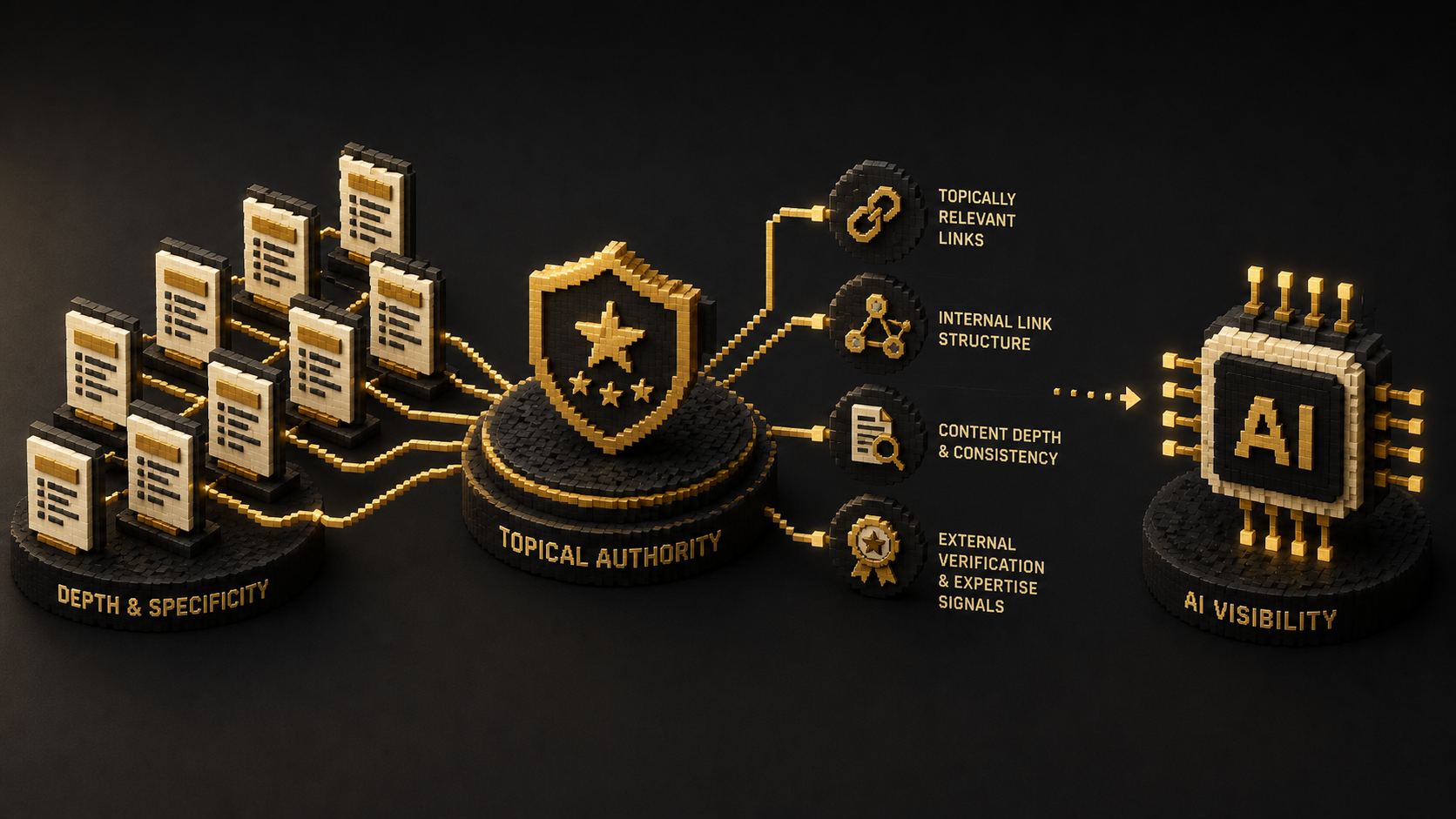
Topical authority and AI visibility are built on the same foundation. The content depth and specificity that build topical authority are the same characteristics that make content citable by AI tools.
Links from websites in the same topical domain reinforce your topical authority far more powerfully than links from unrelated sites. As you build topical authority, prioritize earning links from topically relevant publications and communities rather than general directories.
AI tools evaluate content using signals that substantially overlap with topical authority signals: consistency of expertise across multiple pages, the internal link structure that connects related content, the depth and specificity of individual articles, and the external verification signals from sources in the same subject area.
A site with strong topical authority on a specific subject is, by definition, a site that is well-positioned for AI citation in that subject area. The investment in topical authority serves both traditional Google ranking and AI visibility simultaneously.

Frequently Asked Questions