
Your website has two audiences. The first is human visitors, who read your words, look at your design, and decide whether to reach out. The second is machines: Google's crawler, AI tools like ChatGPT and Perplexity, and every other automated system that reads your site before deciding whether to recommend your business.
The problem is that websites are built primarily for humans. The language is natural. The layout is visual. The meaning is often implied. For a human reading "The PixelSeed Studio builds websites for service businesses that want to be found in AI search," the meaning is clear. For a machine trying to classify your business, assign it to a category, and verify it against other sources, natural language alone is genuinely difficult to parse with confidence.
Schema markup is the solution. Schema markup is structured data you add to your website to help search engines and AI systems understand your content. It uses the schema.org vocabulary to describe things on the web in a format machines can parse: businesses, products, articles, events, people, and hundreds of other types.
In 2026, schema markup is not an advanced SEO tactic. It is foundational infrastructure. Without it, AI tools guess about what your business is and does. With it, they know.

What Schema Markup Actually Is
What is schema markup in plain language?
Schema markup is code that lives on your website and is read only by machines, never by human visitors. It does not change how your page looks. It does not affect your content. It adds an invisible layer of machine-readable description that tells AI tools and search engines exactly what your page represents.
Schema markup is not visible to users visiting your page. It lives in a script block in your HTML head or body, and it is only consumed by machines. Think of it as metadata on steroids: while traditional meta tags give search engines a title and description, schema gives them an entire knowledge graph about your page.
The format recommended for schema markup in 2026 is JSON-LD, which stands for JavaScript Object Notation for Linked Data. JSON-LD is the recommended format for schema markup in 2026, officially confirmed by Google. It sits separately from your HTML, is easy to update, and does not require touching your page design.
In practical terms, an Organization schema block on your homepage looks like a short block of code that explicitly states your business name, your business type, your location, your contact information, your services, and your founding date. A human visitor never sees this. A machine reading your page sees it immediately, extracts the structured information, and uses it to build a precise understanding of your business.

Why AI Tools Specifically Need Schema
Does schema markup affect AI search visibility?
Schema markup is structured data added to a webpage that helps AI systems and search engines classify content, understand entity relationships, and surface it in AI-generated answers. As of 2026, it is the primary technical layer determining AI Overview citation eligibility. Without it, even strong content gets passed over because the machine cannot classify it confidently.
The relationship between schema and AI visibility is more direct than most business owners realize. When ChatGPT Search, Perplexity, or Google AI Overviews retrieve information to generate a recommendation, they are not just reading your text. They are evaluating whether your page is structured in a way that allows them to extract information confidently.
A page with no schema forces the AI to infer. It reads your text, tries to determine what type of entity you are, guesses at your category, and estimates your authority. A page with proper schema provides all of that information explicitly. The AI does not have to infer. It reads the schema and knows.
Schema acts as a universal translator, bridging the gap between human-readable content and machine comprehension. It allows AI systems to move beyond keyword matching to grasp the underlying entities, relationships, and context, thereby enhancing the accuracy and relevance of AI-generated responses and citations.
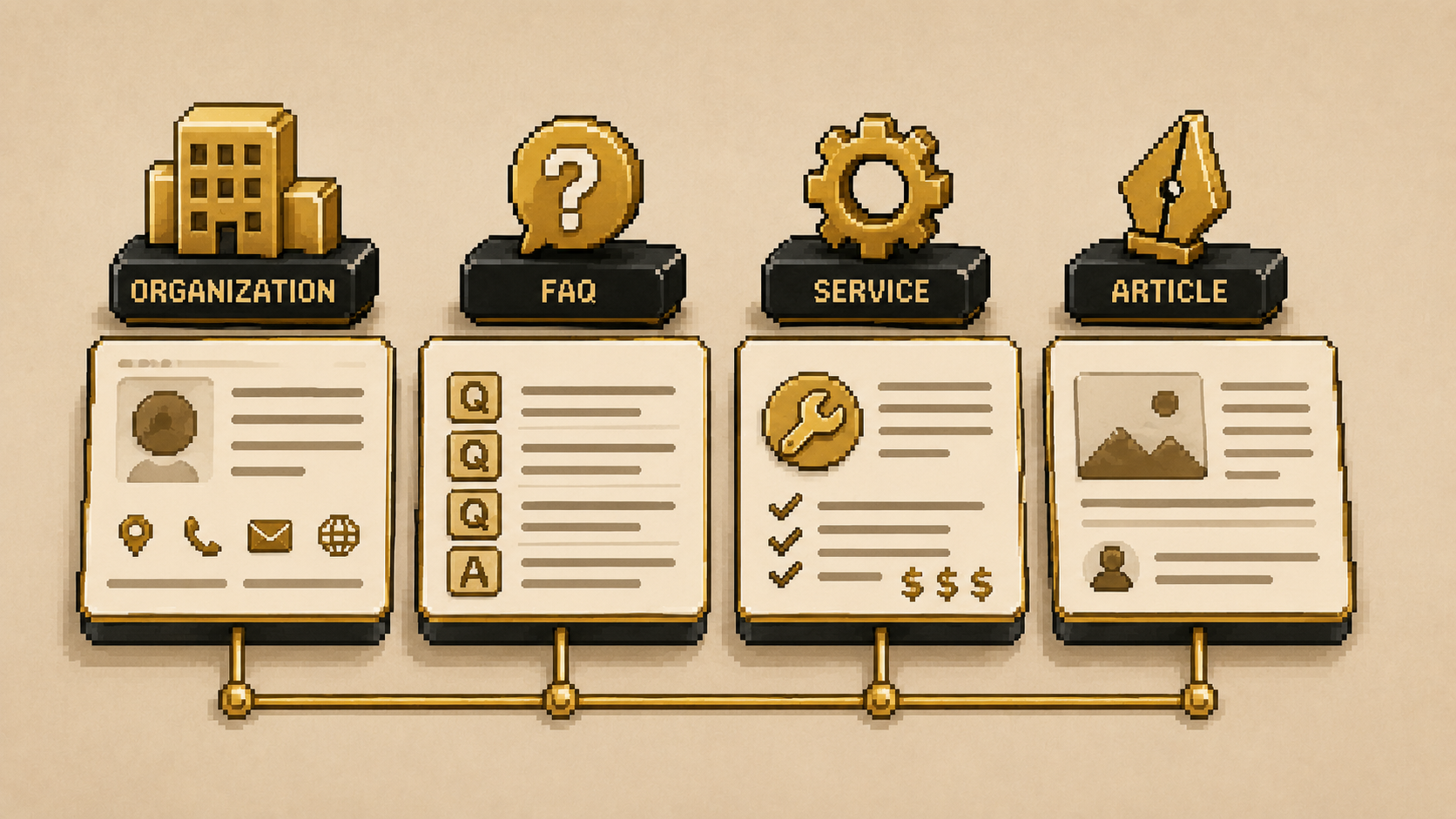
The Schema Types That Matter Most for Service Businesses
Which schema types should a service business implement?
In practice, about ten to fifteen schema types cover the vast majority of use cases for businesses. You do not need all 800 types in the schema.org vocabulary.
For a service business website, these are the four that have the highest impact on AI visibility and should be implemented before anything else.
Organization schema.
This is the foundational identity schema. It tells AI tools exactly who your business is: your name, your type of business, your location, your services, your founding date, your contact information, and your social profiles. For AI, an Organization schema acts as a primary Identity Anchor, ensuring that every mention of your brand is consistently attributed and understood. This is crucial for preventing identity drift, especially when your content is referenced across various platforms.
This schema goes on your homepage. It establishes your business as a recognized entity across every AI system that reads it.
FAQ schema.
This is the highest-impact schema type for AI citation eligibility. FAQPage schema has the highest citation potential of any schema type. AI systems pull FAQ content directly to answer user queries. If you have one schema to implement today, make it this one.
FAQ schema tells AI tools that specific sections of your page are question-and-answer pairs designed to be extracted and presented as direct answers. Pages with FAQ schema are significantly more likely to earn direct citations in AI responses because the AI can identify exactly where the question is and exactly where the answer is, rather than having to find them by reading prose.
Service schema.
This schema type goes on your service pages and tells AI tools exactly what services you offer, who they are for, what the outcome is, and at what price range. Without service schema, AI tools have to read your service descriptions and infer what you actually offer. With it, they know precisely.
Article schema.
This goes on every blog post and article you publish. Article plus Author schema builds E-E-A-T signals and defines content authority. It is essential for blog posts, guides, and thought leadership content. It connects your content to your author identity, establishes a publication date for freshness signals, and tells AI tools that this is an editorial piece written by a named expert rather than a marketing page.

How to Check If Your Site Has Schema Now
How do I know if my website already has schema markup?
Go to search.google.com/test/rich-results and enter your homepage URL. The Rich Results Test is free and takes thirty seconds. It will show you every schema type currently detected on your page, flag any errors in existing schema, and tell you which rich result types your page is eligible for based on the schema present.
If the tool returns no structured data, your site has no schema markup. This is the single most common technical AI visibility problem we find when auditing service business websites. The content may be good. The design may be professional. But without schema, AI tools are guessing about what your business is, and guesses produce inconsistent recommendations.
Schema audits should run monthly because CMS updates, theme changes, and plugin conflicts can silently break schema output. A full first audit takes three to four hours, while subsequent monthly checks take under an hour. Use Google Search Console enhancement reports to monitor valid, invalid, and warning counts for each schema type.
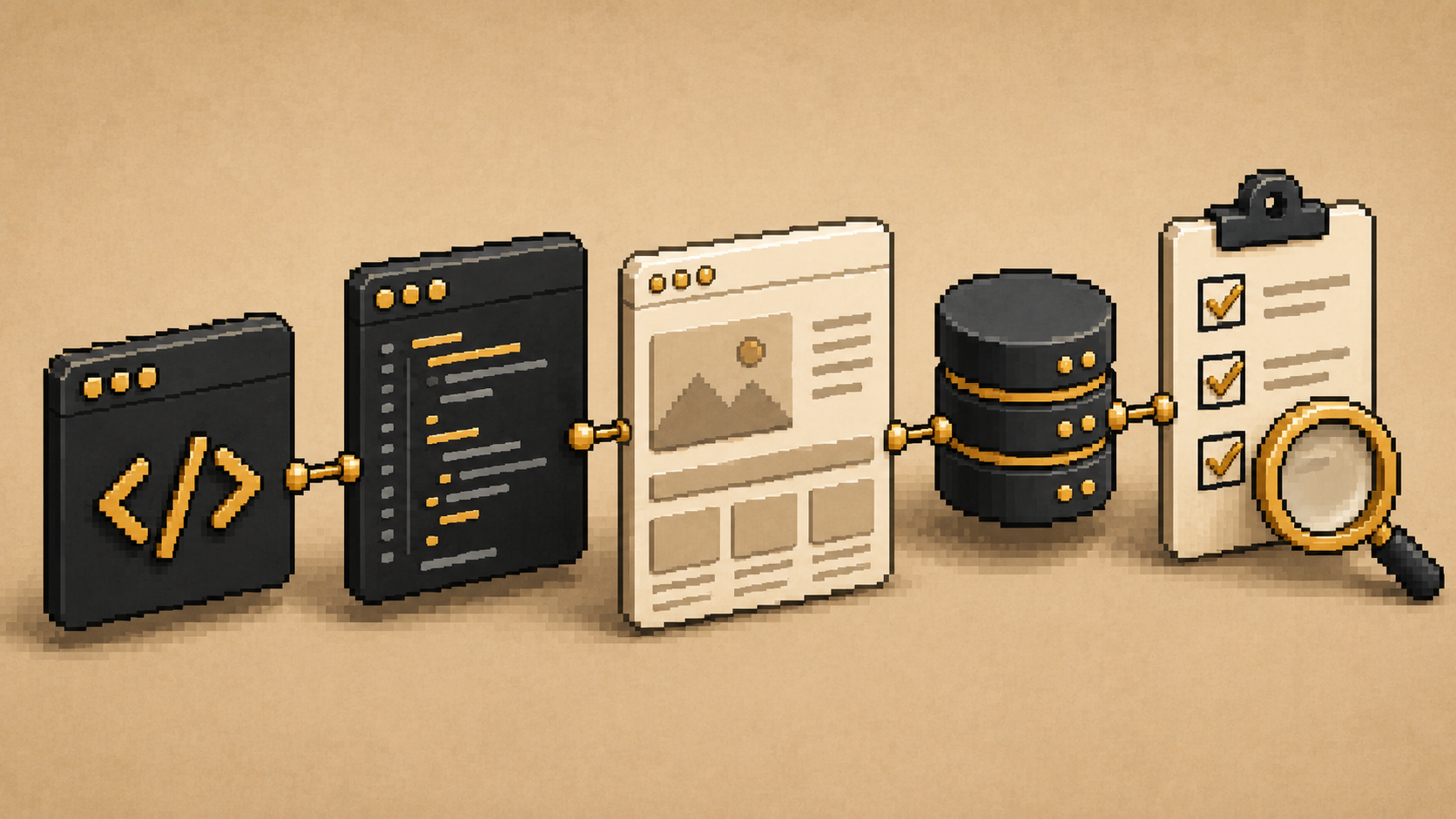
How to Implement Schema Markup
How do I add schema markup to my website?
The method depends on your website platform.
On Webflow:
Schema markup is added as a custom code embed in the page settings or site settings depending on whether it applies to the whole site (Organization schema) or a specific page (FAQ schema, Service schema). This is a developer task that takes approximately one to two hours for a standard service business website.
On WordPress:
Plugins like Rank Math and Yoast SEO include schema markup generation. However, for AI visibility, manually written and validated JSON-LD is more reliable than automatically generated schema because you can ensure every field is accurate and complete.
On any platform:
Schema markup can be added manually as a JSON-LD script block in the HTML head of any page. This requires a developer who understands JSON-LD syntax. The implementation itself is not complex but needs to be validated after completion.
Every schema implementation should be validated with Google's Rich Results Test before publishing and monitored in Google Search Console after launch. Schema markup is a core part of on-page SEO, not an advanced add-on.
The most important thing is not which method you use. It is that the schema is implemented correctly, validated before it goes live, and contains accurate information that matches the visible content on the page.

The One Mistake That Breaks Schema Silently
What goes wrong with schema markup most often?
The most common and most damaging schema mistake is marking up content that does not appear visibly on the page. Marking up content that does not exist on the page, using fake review schema, or implementing schema that contradicts your visible content can result in Google manual actions. Implemented correctly, schema cannot hurt you.
If your FAQ schema lists questions and answers that are not actually visible to human visitors on that page, the schema is invalid. If your Organization schema lists services you do not actually offer, the schema creates a conflict between what the machine reads and what a human sees. Both cases reduce your credibility with AI tools rather than improving it.
The rule is straightforward: schema markup should describe exactly what is on the page, in the same language and with the same information. It is a machine-readable description of visible content, not an additional channel for claims that are not supported by the page itself.

Your Schema Implementation Checklist
Before going live with any schema markup, confirm all five of these.
- Organization schema is on your homepage with accurate business name, type, location, contact information, and service categories.
- FAQ schema is on every page that contains a question-and-answer section, with questions and answers that match exactly what is visible on the page.
- Service schema is on your primary service pages.
- Article schema is on every blog post with a named author linked to a Person or author profile.
- All schema has been validated through the Rich Results Test at search.google.com/test/rich-results with no errors.

Frequently Asked Questions