This is a situation that more business owners are discovering in 2026. The Google rankings are reasonable. The traffic is consistent. The traditional SEO effort has produced real results. And yet, when you open ChatGPT and ask about your category, your business does not appear. When you check Perplexity, a competitor is cited instead of you.
The conclusion most people reach is that something is wrong with their SEO. The actual explanation is simpler and more specific: SEO and AI visibility are different measures that require different strategies, and good performance on one does not predict good performance on the other.
Only 38% of pages cited in AI Overviews also rank in the top ten of traditional search, down from 76% just seven months prior. This means SEO rank no longer guarantees AI visibility. You need both strategies running in parallel.
This article explains the specific gap between SEO performance and AI visibility, what causes it, and what to add to your existing strategy to close it.
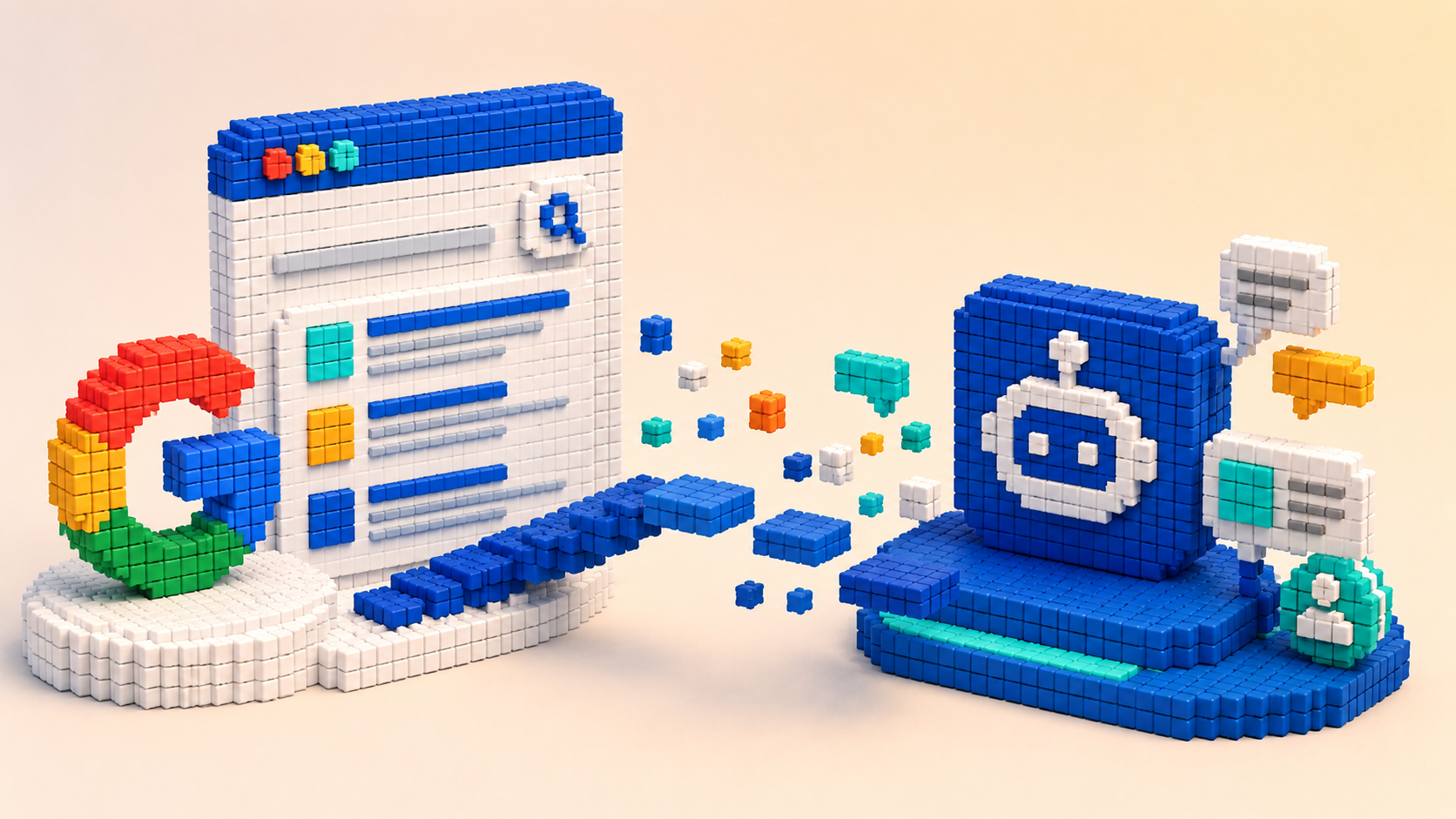
Why SEO Performance and AI Visibility Diverge
Why does ranking on Google not guarantee AI search visibility?
The signals that earn Google rankings and the signals that earn AI citations overlap but are not the same.
Google's ranking algorithm weighs keyword relevance, technical performance, backlink authority, and content quality in a way that was designed to produce a ranked list of links. The algorithm rewards pages that are the most relevant match for a specific query and the most authoritative source for that topic area.
AI tools do not produce ranked lists. They synthesize information and produce a direct recommendation. The signals they evaluate include whether your content is structured so specific answers can be extracted from it without surrounding context, whether your business information is consistent across every platform they read, whether your content is specific and verifiable enough to be cited as a source rather than paraphrased anonymously, and whether external sources verify your authority.
A page can be keyword-optimized, technically sound, and backed by strong backlinks while still failing all four of these AI citation criteria. The keyword targeting that earns Google rankings does not address content extractability. The backlinks that build domain authority do not directly address entity consistency across directories. The technical SEO that satisfies Core Web Vitals does not automatically produce schema markup.

The Four Specific Gaps
What specific differences between SEO and AI visibility do I need to address?
Gap 1: Content that ranks but cannot be extracted.
A well-optimized page that covers a topic comprehensively, using keywords appropriately, in a format that Google rewards, may still be written in a way that AI tools cannot cleanly extract answers from. If every section of the page is a flowing discussion of the topic rather than a direct answer to a specific question, AI tools have nothing to lift and attribute. The content is readable and useful to humans but not extractable by AI systems.
The fix is to add question-format headings to every major section and rewrite the first sentence of each section to be the complete answer to that heading question. This does not require changing the overall content. It requires restructuring the opening of each section.
Gap 2: Strong domain authority but weak entity signals.
Backlinks and domain authority tell Google that your site is credible. They do not tell AI tools what your business is, what category it belongs to, or where it is located. AI tools build entity models from specific signals: Organization schema on your homepage, consistent NAP data across directories, active Google Business Profile, LinkedIn company page alignment.
A site with strong backlink authority but no schema markup and inconsistent directory listings has strong SEO signals and weak AI entity signals simultaneously. Fixing this requires adding the entity layer that SEO investment alone does not address.
Gap 3: Page-one rankings on Google but no Bing indexing.
ChatGPT Search draws from Bing's index. A site that has invested exclusively in Google SEO and has never submitted to Bing Webmaster Tools or optimized for Bing's crawler may have excellent Google rankings and minimal Bing visibility, which translates directly into reduced ChatGPT Search citation eligibility.
The fix is simple: submit your site to Bing Webmaster Tools at bing.com/webmasters. It is free and takes under ten minutes. This ensures Bing is actively crawling and indexing your pages for ChatGPT retrieval.
Gap 4: Good content but no FAQ schema.
FAQ schema is one of the most direct signals that AI tools use to identify extractable question-and-answer content. A page with great FAQ content but no FAQ schema requires AI tools to infer which text is a question and which is its answer. A page with FAQ schema makes this structure explicit. The schema-equipped page consistently performs better in AI citation tests than the equivalent page without schema.
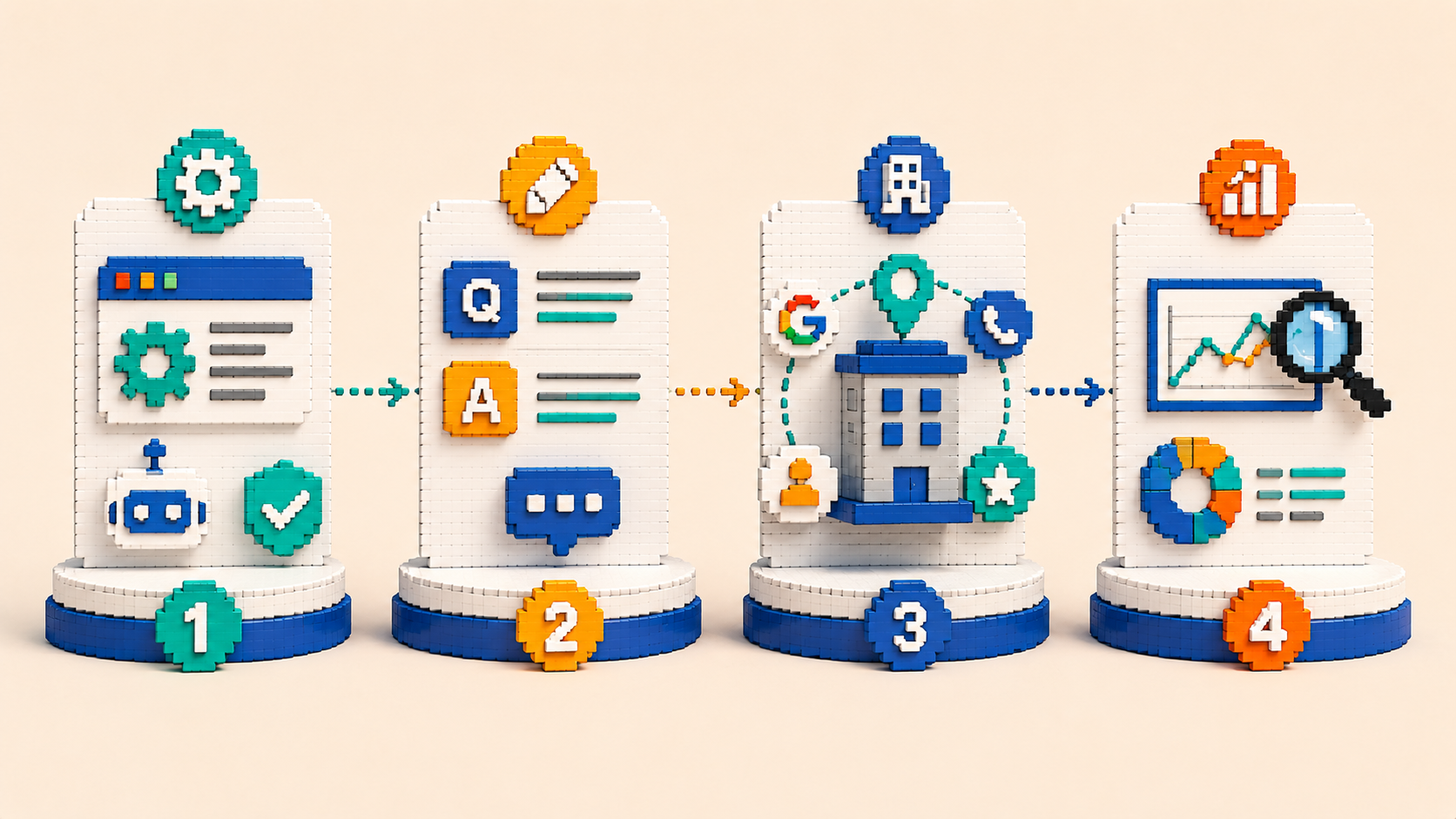
What Adding AI Visibility to SEO Actually Looks Like
How do I add AI visibility to an existing SEO strategy?
The good news is that the additions required to close the gap between your SEO performance and your AI visibility are modest and targeted. You do not need to rebuild your SEO strategy. You need to add the AI visibility layer on top of it.
Week 1: Technical foundation.
Check robots.txt for AI crawler access. Submit to Bing Webmaster Tools if not already done. Run your homepage through the Rich Results Test to identify schema gaps. These are developer tasks that can typically be completed in a single working session.
Week 2: Content restructuring.
Go through your three most-visited service pages and blog articles. Add question-format headings to the three most important sections of each page. Rewrite the first sentence of each section to be a complete, standalone answer to the heading question. Add or expand FAQ sections at the bottom of each page.
Week 3: Entity layer.
Verify that your Organization schema on the homepage is accurate and complete. Check your Google Business Profile for completeness and recent updates. Search your business name in Google and compare your name, address, phone number, and service descriptions across your website, Google Business Profile, and the first three directory listings that appear. Fix any inconsistencies.
Week 4: Measurement.
Run ten queries across ChatGPT, Perplexity, and Gemini asking about your category and comparing results to your pre-optimization baseline. Set up the AI Search custom channel in GA4 to track referrals from AI platforms. Record both sets of data as your new baseline.

Your SEO-to-AI Gap Diagnostic: Score Yourself Today
This check measures the specific gap between your traditional SEO performance and your AI visibility. Score one point for each yes.
1. When you view the raw HTML source of your homepage (press Ctrl+U or Cmd+Option+U in your browser), is your actual page content, including headings, service descriptions, and FAQ answers, visible as readable text rather than JavaScript code?
2. Does every major section of your service pages and blog articles have a heading phrased as a question, with the complete answer appearing in the first sentence of the section?
3. Does your homepage have Organization schema implemented and validated through search.google.com/test/rich-results, with no errors flagged?
4. Is your business name, address, phone number, and service description identical across your website, your Google Business Profile, and at least three directory listings when you search your business name in Google?
5. Have you submitted your site to Bing Webmaster Tools at bing.com/webmasters? (ChatGPT Search draws from Bing's index. This is the most commonly missed AI visibility step for businesses with otherwise solid Google SEO.)
Score 5: Your SEO and AI visibility foundations are aligned. The gap between your Google performance and your AI citations is likely a content specificity and GEO issue rather than a technical one. Focus on deeper, more specific content with named expertise and cited statistics.
Score 3 to 4: You have solid SEO but one or two AI visibility gaps. The additions required are targeted, not structural. The weekly additions described in this article cover each gap specifically.
Score 2 or below: Your SEO investment has built Google performance on a foundation that AI tools cannot yet read properly. The good news is that the fixes are additive, not replacements of what is already working. You do not need to redo your SEO. You need to add the AI visibility layer on top of it.

Frequently Asked Questions